
PROJECT LEARNING PATH
Window Blinds Measuring & Ordering Hub
Decide between inside and outside mount, record three-point window measurements, and understand product-specific deductions before ordering blinds.
Ordering blinds begins with which surface carries the brackets. Inside-mount treatments sit in the recess and depend on its usable width and depth. Outside-mount treatments cover an opening from the wall or trim and depend on overlap, headrail position and bracket support.
The same window can accept either style, but the measurements are not interchangeable. Do not buy from a generic calculator output alone: window-covering manufacturers often use their own order-width, factory-clearance and finished-fabric conventions.
Repair before replacement: vane, tilt and roller-shade decisions
Mounting measurements and mechanical repair are different tasks. For a damaged or stuck window treatment, identify its control type and failure mode first. Only if replacement is needed should you use the measuring instructions for the exact new product.
On a narrow screen, scroll this table sideways to see every column.
| Actual symptom | Troubleshooting guide | Do not confuse with |
|---|---|---|
| Vertical blinds slide across the rail but refuse to rotate | Vertical blinds won't rotate | A broken or missing individual vane |
| One vertical slat is cracked, hanging low or missing | Replace vertical blind vanes | Replacing the full tilt/traverse mechanism |
| Roller fabric winds diagonally toward one bracket | Roller shade rolling crooked | A spring-tension failure |
| Roller will not rise, hold or responds incorrectly | Roller shade won't roll up | A fabric-tracking issue |
| Cordless slatted blind won't lift normally | Cordless blinds won't lift | A cellular shade mechanism |
Before touching any controls, preserve cord and chain tensioners and verify whether the system is spring, cordless, chain-operated or motorized. Measure installed vane headrail-to-bottom drop only if the supplier actually requests that value. A made-up “standard deduction” may cause a return or a safety problem.
First identify the exact shade or blind
A product's name is not enough to choose a height rule or deduction. Blinds.com's published wood-blinds guide and roller-shades guide explain different ways to take and use recess measurements.
On a narrow screen, scroll this table sideways to see every column.
| Before entering an order | Record | Why it prevents a return or poor fit |
|---|---|---|
| Chosen product | Full maker, model and current measuring sheet | A generic brand guide may differ from a product PDF |
| Mount type | Inside/outside; minimum unobstructed bracket depth | A narrow recess can rule out the intended brackets |
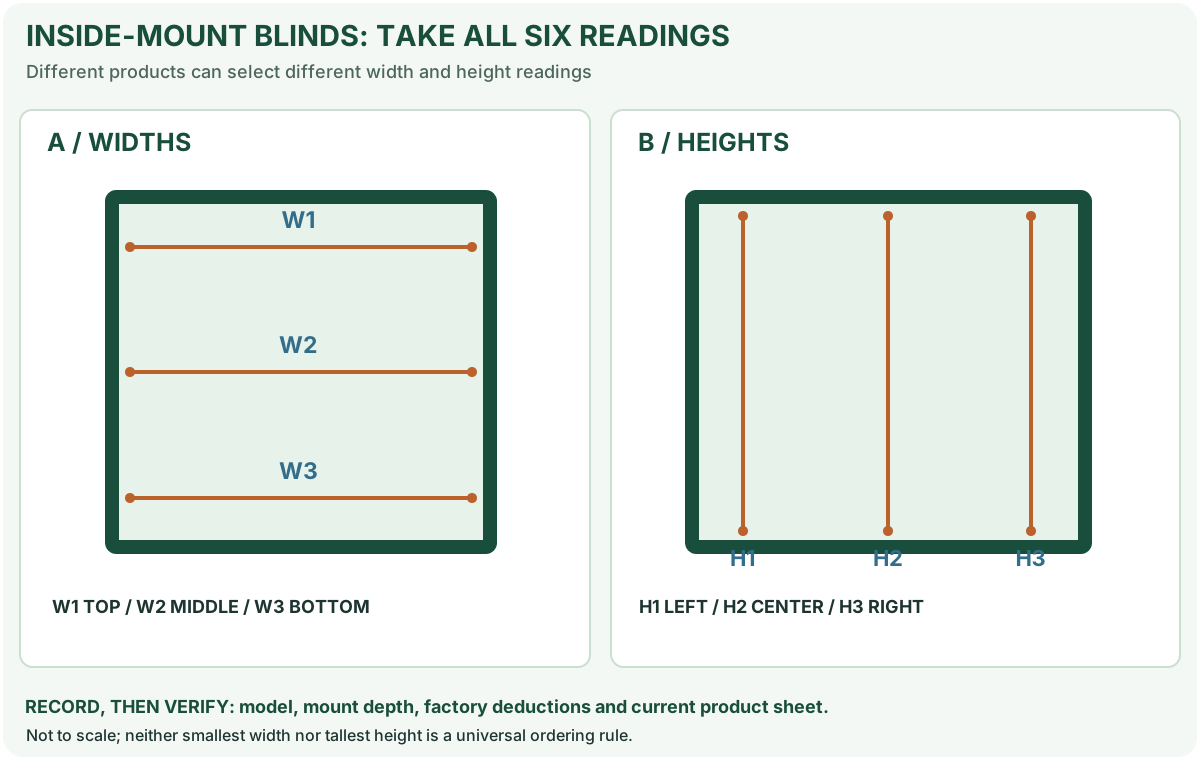
| Width readings | Top, middle, bottom without averaging | Some wood-blind instructions select the smallest width; roller-shade guidance may use top width |
| Height readings | Left, middle, right, even when only one value is requested | Different product sheets can use different height conventions |
| What the order width means | Opening, headrail, bracket-to-bracket or finished fabric | The fabric can be narrower than its hardware |
If vendor documents disagree for the exact shade, stop before ordering and request clarification for the SKU. Our blind helper stores the readings and shows method-specific references, but does not certify an order.
Inside mount or outside mount?
On a narrow screen, scroll this table sideways to see every column.
| Installation | Good starting situation | Important checks |
|---|---|---|
| Inside mount | Adequate recess depth and relatively straight jambs | Narrowest width, multiple heights, brackets, obstruction clearance, product depth |
| Outside mount | Shallow recess, irregular trim or extra coverage desired | Overlap on both sides, headrail mounting surface, desired top/bottom extent |
If your opening narrows from top to bottom, do not average away the narrowest width. If cranks, handles, tile or trim interfere, mark where the headrail will actually sit. For outside mounting, inspect whether the wall or trim can support the manufacturer's brackets.
Before measuring: which mount belongs on this window?
Our inside-mount versus outside-mount decision guide compares usable recess depth, obstruction clearance, side light gaps, bracket support and three worked examples. A window that looks square in a photo can still have three different widths; decide the mounting reference before entering a vendor order size.
A reliable measurement routine
- Make a separate record for each window—even windows beside each other can differ.
- Check whether the manufacturer labels ordering dimensions as finished fabric, headrail or overall covering sizes.
- For inside mounting, record widths at the top, middle and bottom; heights at left, center and right; and the clear usable mounting depth.
- For outside mounting, first decide the top bracket location, side overlap and desired lower coverage. Then calculate total intended area without calling it the final order size.
- Review the exact product's height and width rules. Some products use the longest height; others, including certain vertical and banded treatments, can use the shortest.
- Check whether the factory makes width deductions. Do not subtract clearance twice when the instructions specify the factory will do so.
- Record any window handle, trim corner, radiator or door swing that changes the installation plan.
Match the measuring rule to the exact product — not just the word “blind”
Blinds.com publishes both a general measuring hub and a separate roller-shade guide. A narrower top measurement can be relevant for the roller-shade workflow, while traditional blinds often require the smallest of top/middle/bottom widths. Those methods describe the vendor's specific instructions, not a rule for every product with that name.
On a narrow screen, scroll this table sideways to see every column.
| Before entering an order | Record this from the chosen product listing |
|---|---|
| Product identity | Brand, complete model/SKU and current measuring sheet |
| Mounting position | Inside or outside; mounting depth and obstruction clearance |
| Width position | Top only, smallest of three, or another specified position |
| Height convention | Longest, shortest, or a product-defined measurement; conflicting documents must be resolved with seller |
| Deductions and rounding | Whether the factory adjusts dimensions and the required increment |
Stop if the product PDF conflicts with a generic vendor page. Keep both observed heights in the worksheet; ask the seller which applies to your SKU. Use the inside-mount helper to record measurements, not to certify an order.
Worked example: the product rule matters
Suppose a recess measures 35 1/8, 35 and 35 1/16 inches wide, and 58, 58 1/8 and 58 inches high. The width record's minimum is 35 inches; the height record's minimum is 58 inches and maximum is 58 1/8 inches. A product using longest-height ordering would use a different height than one using shortest-height ordering. Check its own measuring guide before placing the order.
For outside mount, a 36-inch opening with 2 inches of overlap on each side yields 40 inches of intended coverage. Adding 3 inches above and 2 inches below a 48-inch-high opening yields 53 inches of intended height. Those are geometry measurements, not necessarily the vendor's order form values.
Free tools for your worksheet
Use our inside-mount helper to compare multiple readings, outside-mount coverage planner for overlap arithmetic, and printable project worksheet for a take-to-store record.
Manufacturer reference
The LEVOLOR PREMIER January 2025 general measuring guidelines describe product-category exceptions, minimum mounting concerns and manufacturer deductions. They are a real maker's reference, not a universal rule for competing products. Always consult the exact model instructions and check child-safety requirements, particularly for older corded treatments.
GUIDES BY PROJECT
Continue with a specific task
Open the guide that matches your measurement or repair problem.
Illustrative imageWindow measurementsHow to Measure for Inside-Mount Blinds Without Guessing
Compare wood blinds, roller shades and Pick and Ship measurements with vendor-specific width, height, rounding and deduction examples.
Read guide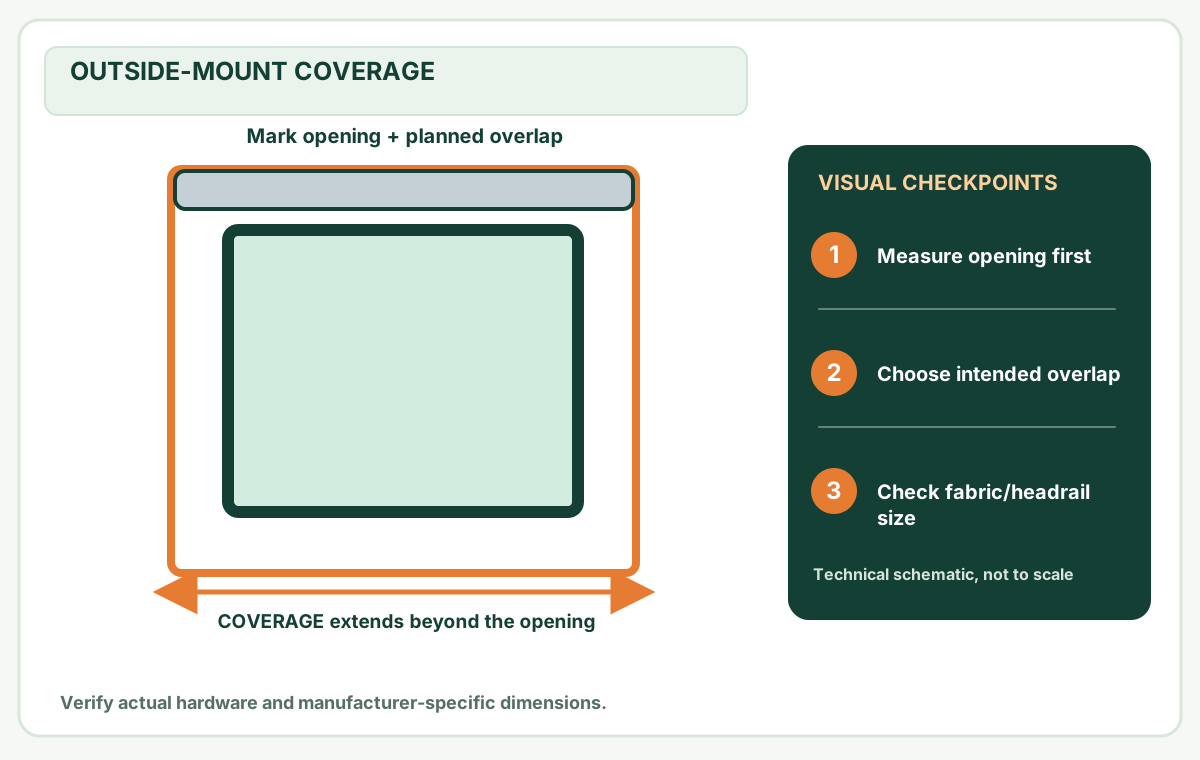 Illustrative imageWindow measurements
Outside-Mount Blinds: Measure Coverage, Fabric and Order Width
Measure outside-mount blinds using actual fabric, bracket and order widths; compare three conflicting manufacturer sizing conventions before purchase.
Read guide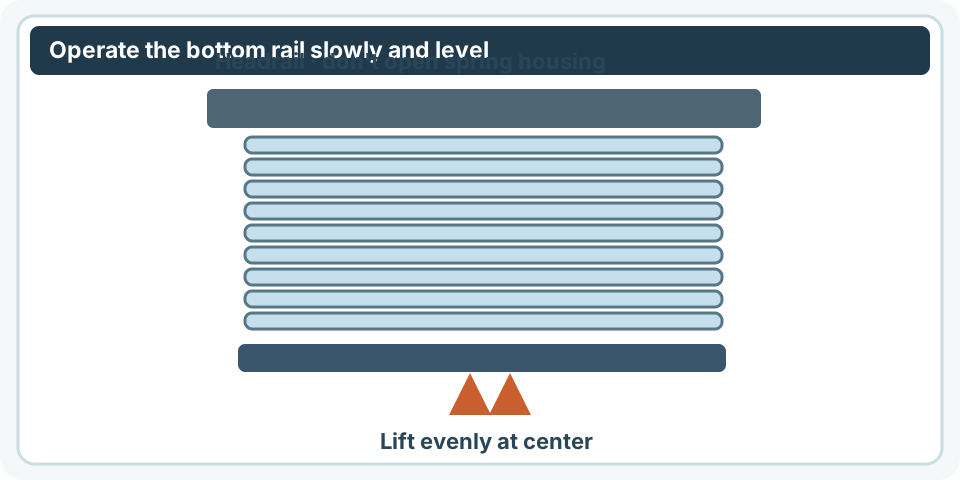 Illustrative imageBlinds & shades
Cordless Mini Blinds Won't Lift? Identify the Fault Before Resetting
Diagnose cordless mini blinds with stuck, skewed or dropping bottom rails, distinguish them from cellular shades, and follow the correct product-specific spring or service path.
Read guide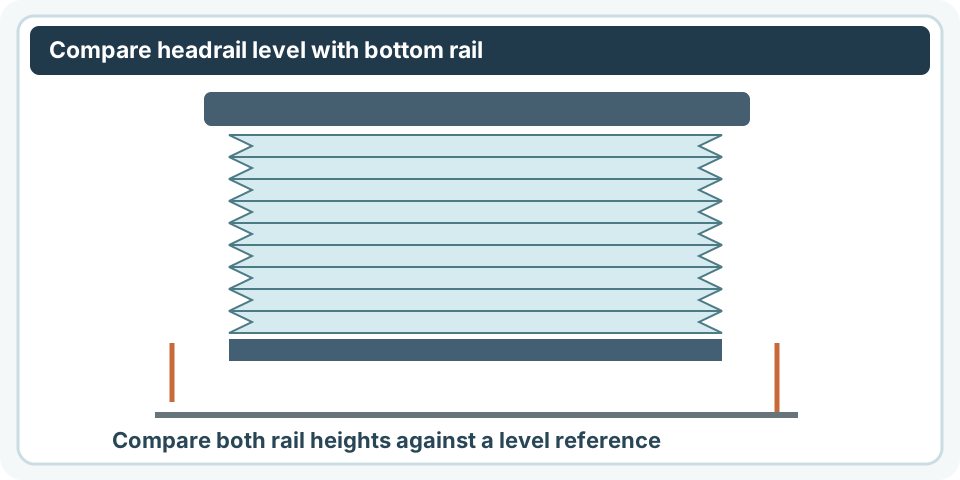 Illustrative imageBlinds & shades
Cordless Cellular Shades Uneven or Sagging? Diagnose Safely
Troubleshoot honeycomb shade bottom-rail tilt, sagging, creeping and noisy movement with model-specific checks before considering repair or replacement.
Read guide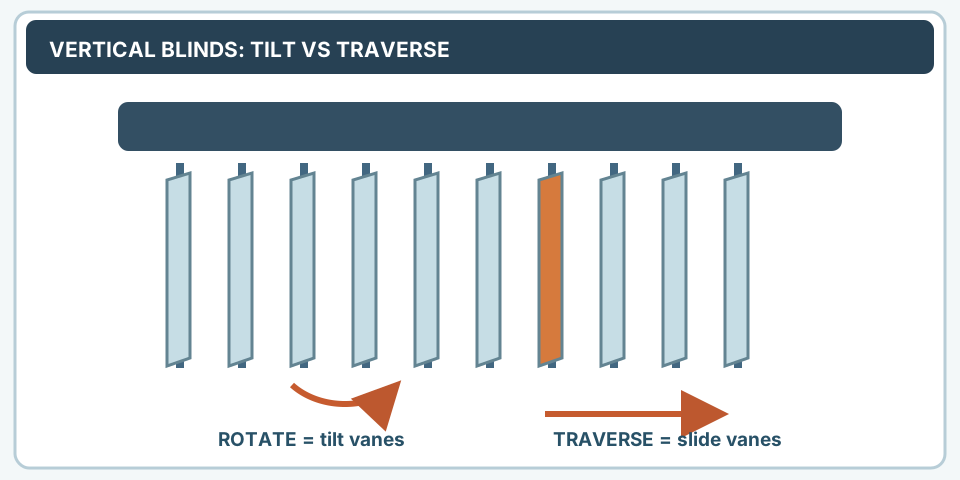 Illustrative imageBlinds & shades
Vertical Blinds Won't Rotate? Diagnose Vanes, Carrier Stems and Controls
Troubleshoot vertical blinds that won't tilt without forcing a chain, wand or carrier rod. Check obstructions, vane alignment and manufacturer systems.
Read guide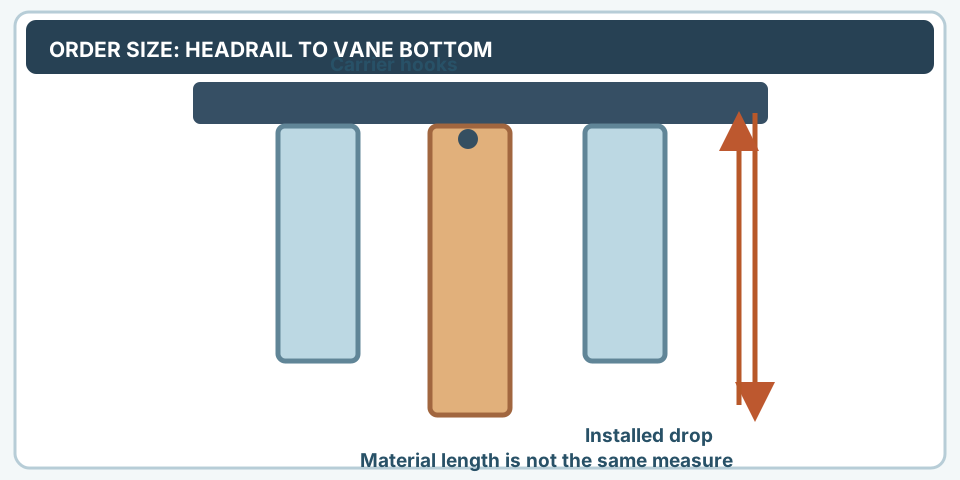 Illustrative imageBlinds & shades
Replace Vertical Blind Vanes: Measure Length and Match Carrier Hooks
Replace broken vertical-blind slats without buying an incompatible vane. Identify carrier hooks, order conventions, hanger orientation and clearance.
Read guide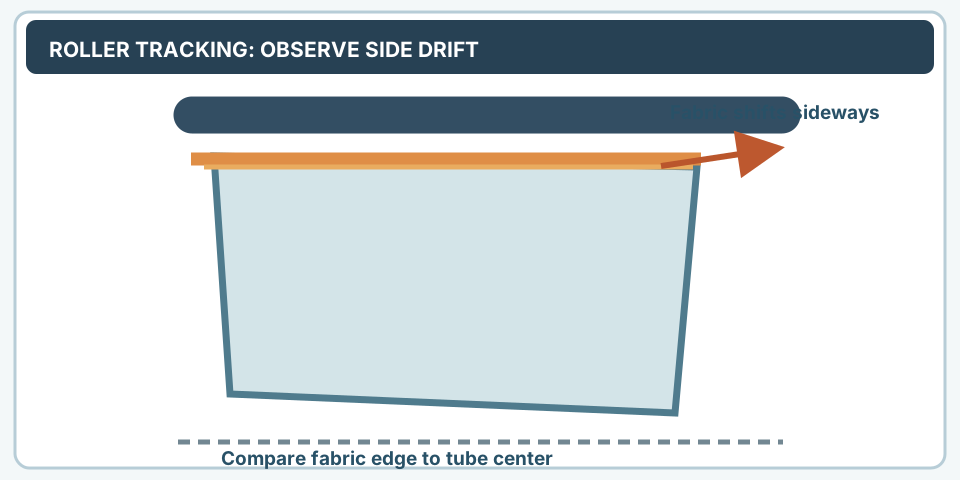 Illustrative imageBlinds & shades
Roller Shade Telescoping? Diagnose Crooked Fabric Tracking
Find why a roller shade winds sideways, tell bracket tilt from fabric telescoping, and use a source-specific left/right shim diagram only when the manufacturer permits it.
Read guide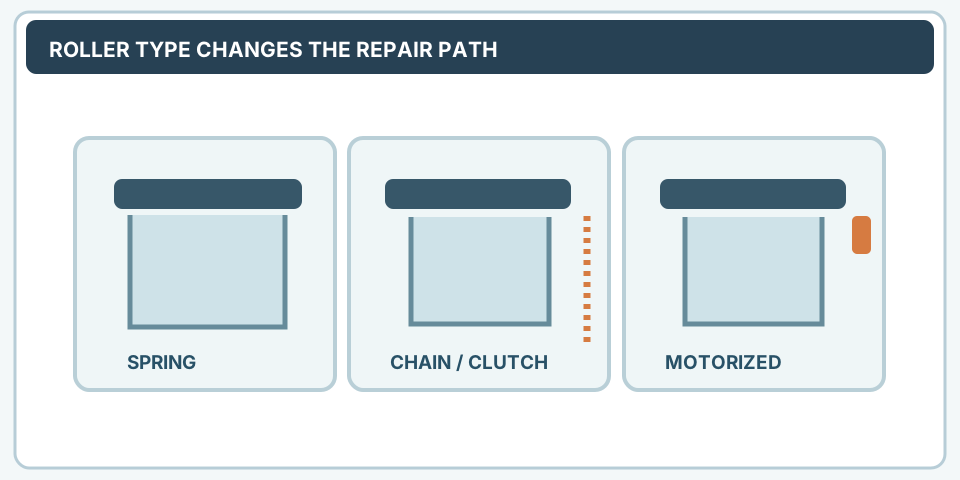 Illustrative imageBlinds & shades
Roller Shade Won't Roll Up? Check Control Type Before Adjusting Tension
Troubleshoot a spring roller shade that won't rise, a cordless shade that creeps, or a motorized shade that stops without damaging a tension mechanism.
Read guide