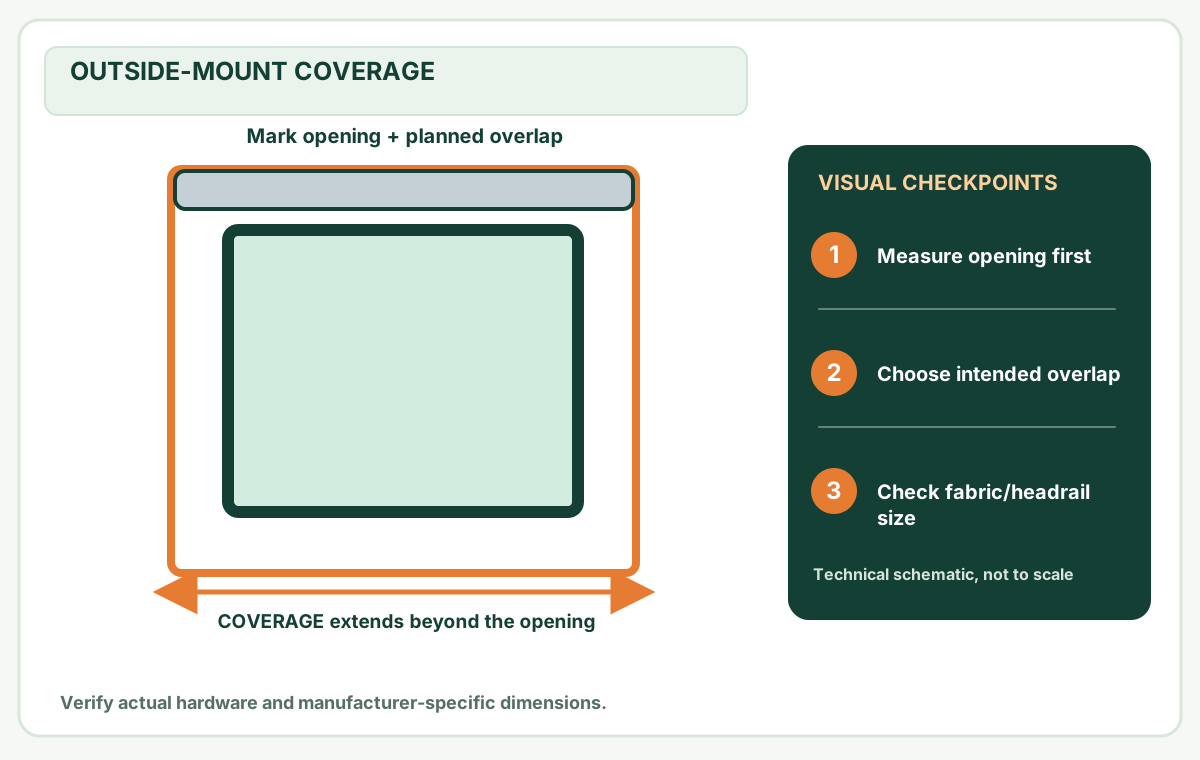
Record the width at three points. Do not apply one universal height or factory-deduction rule to every blind type.
Before you buy or repair
- Record first
- Three widths, three heights, bracket depth and obstructing handles
- Make the decision
- Apply the CURRENT exact model/SKU measuring guide, including its deduction and height rule
- Stop & verify if
- Manufacturer documents disagree, mounting depth fails or the opening is severely tapered
Jump to a section
- Diagram checkpoints
- Quick answer: collect the measurements before picking an order rule
- Compare the published rules — scope matters
- A third current Blinds.com exception: inside-mount vertical blind versus replacement vane
- Important: a source conflict you must resolve before ordering
- Worked example: one window, different reference methods
- Measure safely and consistently
- Stop and verify instead of guessing
- Ordering from the USA, Canada or UK: measurements are not universal SKUs
- A verified manufacturer-document conflict: do not guess which height to order
- Source and further reading
- After the project: did it work?
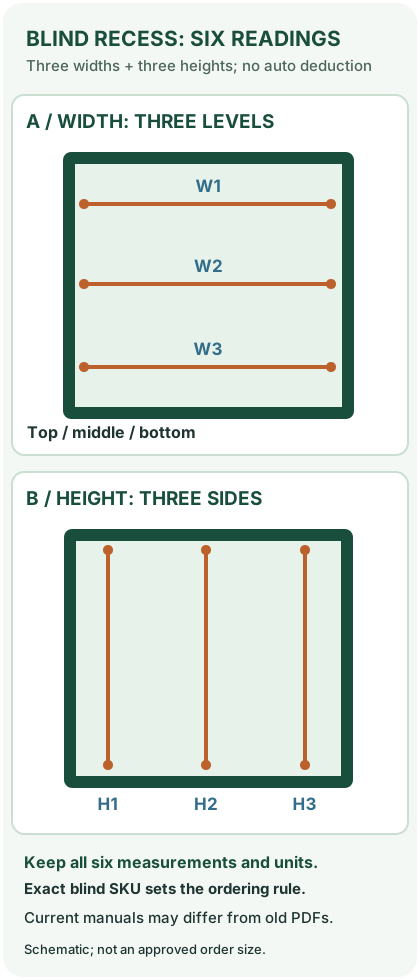
Open desktop diagram ↗ Open mobile diagram ↗
Read the diagram: three checkpoints
- Widths: top / mid / low
- Heights: left / mid / right
- Follow exact product rule
An inside-mount blind fits inside the window opening. The correct order dimensions depend on the exact blind or shade: a general wood-blind guide, a roller-shade PDF and a stock-size product can require different actions. This guide helps you record accurate opening dimensions and identify which vendor rules apply; it does not supply a guaranteed final order size.
Quick answer: collect the measurements before picking an order rule
Record top, middle and bottom opening widths, left, center and right heights, the minimum usable mounting depth, any obstructions, and the full product name/SKU. Use a steel tape at the intended bracket depth. Keep the readings in their original fractions: for example, 35 1/8 inches, not a mentally rounded 35 inches.
On a narrow screen, scroll this table sideways to see every column.
| Decision | What to record | Why it changes the order |
|---|---|---|
| Product model | Brand, SKU and link to its Measure & Install document | The same retailer publishes different instructions for different models |
| Width | Top/middle/bottom at mounting depth | Some products use narrowest width; certain rollers use top only |
| Height | Left/center/right at mounting depth | Different products and documents may specify tallest or shortest |
| Installation clearance | Minimum usable recess depth, handle position and bracket surface | A correct width still cannot rescue a headrail that does not fit |
| Width deductions | Who adjusts the opening measurement: factory or buyer | Applying a deduction twice may create excessive side gaps |
Try the printable worksheet or fraction converter if you need to record several windows. Your measured opening is not automatically the finished blind dimension.
Compare the published rules — scope matters
These are examples of published vendor instructions, not universal rules for all wood blinds or roller shades. Confirm the exact product page before placing an order.
On a narrow screen, scroll this table sideways to see every column.
| Source and scope | Width reading | Height reading | Adjustment responsibility |
|---|---|---|---|
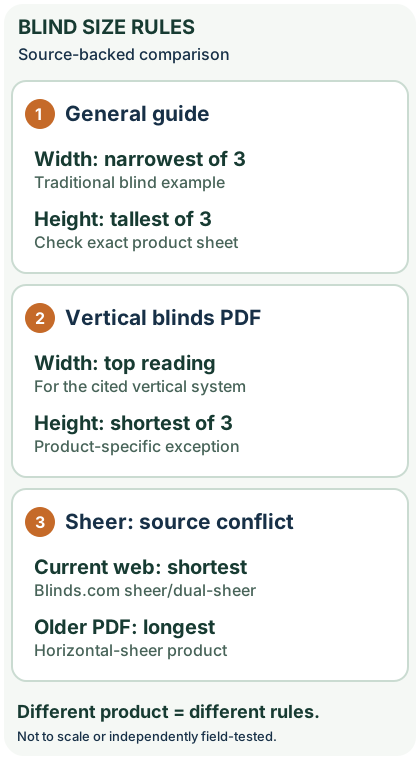
| Blinds.com inside-mount wood blinds web guide | Narrowest of top/middle/bottom | Tallest of left/center/right | Confirm the model's factory deductions |
| Blinds.com roller-shade web guide | Top opening width | Tallest of three heights | Web guide says order at opening size; confirm selected product |
Blinds.com roller/solar PDF — filename with and |
Top opening width | Shortest of three heights | Apply only when the exact product uses this PDF |
Blinds.com roller/solar/sheer PDF — filename without and |
Top opening width | Tallest of three heights | Apply only when the exact product uses this PDF |
| Blinds.com Pick-and-Ship faux-wood blinds | Narrowest width, with the guide's buyer-side 1/2-inch deduction and stock-size rounding | Product-specific height choices | Buyer follows the particular stock-line instructions; do not assume factory deductions |
A third current Blinds.com exception: inside-mount vertical blind versus replacement vane
The seller's current vertical blind measuring guide gives a specifically different choice from its wood-blind and roller-shade guides:
On a narrow screen, scroll this table sideways to see every column.
| Product/order type | Width reference | Height reference | Important distinction |
|---|---|---|---|
| Complete inside-mount vertical blind (cited current Blinds.com category) | Top of the opening only | Shortest of left/center/right opening heights | The page says order the opening dimensions with no buyer deduction; the factory handles its stated allowance |
| Replacement vertical-blind vane (existing headrail) | Match old vane width and original carrier geometry | From top of installed headrail to bottom of undamaged vane, as specified by Blinds.com's replacement-vane rule | This is not an inside-mount opening height or a measurement of the old material alone |
| Traditional horizontal wood blind (other guide) | Typically narrowest of three opening widths | Often tallest height under the named product guide | Do not use the wood-blind height reference for the vertical-blind product |
Worked complete-blind example: opening top width 47 3/16 in; left height 80 5/16 in, center 80 1/16 in, right 80 1/4 in. The vertical guide selects top width and the shortest observed height, 80 1/16 in. Its basic measuring instructions say to record in 1/8-in increments, rounding a reading exactly on a 1/16-in mark down to the lower 1/8. Following those source-specific rules gives illustrative entered dimensions 47 1/8 × 80 in. This is not an approved order for an unidentified SKU or a claim that a 1/8-in height rounding is appropriate for another blind manufacturer.
If you are buying only a broken vane for an existing rail, do not use 80 in as its length. The replacement-vane supplier requires a different measurement reference. The dedicated replacement-vane guide shows how to document it.
Important: a source conflict you must resolve before ordering
The documented source conflict: Blinds.com currently hosts two distinct roller measuring PDFs: the one with roller-and-solar in its filename says shortest, while the one with roller-solar-sheer says tallest. Its general roller-shade web page also says tallest. They are not interchangeable, and neither should be applied to an unrelated SKU. If the listing links to one PDF but customer support cites the other, stop and ask which current document governs the product.
Worked example: one window, different reference methods
A recess measures 35 1/8, 35 and 35 1/16 inches wide. Heights are 58, 58 1/8 and 58 inches. The opening record is:
- Top-only width: 35 1/8 in; narrowest of three: 35 in.
- Tallest measured height: 58 1/8 in; shortest: 58 in.
- Product ID, unobstructed depth and treatment type: not yet confirmed.
The wood-blind reference method selects the smallest measured width and tallest measured height. The roller-shade web method uses top width and tallest height. The roller-and-solar PDF would select top width and shortest height. Those are different documented reading conventions, not three different approved order sizes. The selected product might need a buyer deduction, factory deduction or different rounding before an order can be entered.
Measure safely and consistently
- Open the selected product's measuring and installation sheet, record its URL and the revision date if shown.
- Check the minimum and fully recessed bracket depths; note cranks, sensors, tile edges and projection into the opening.
- Measure widths at top, middle and bottom at the bracket-mounting depth, keeping all three original readings.
- Measure heights at left, center and right. Record the three actual numbers even if the product ultimately uses just one.
- Check whether the opening narrows or is out of square. Do not average mismatches into a seemingly convenient width.
- Read the deductions and rounding section for your exact SKU. Never subtract 1/2 inch merely because another product line instructs its buyers to do so.
- Save the product sheet with the worksheet, then double-check that all order fields specify width × height in the vendor's required units.
A stable step stool can help for high openings; never lean outside an upper-floor window to reach the frame. If measurement or installation would be unsafe, use a qualified installer.
Stop and verify instead of guessing
On a narrow screen, scroll this table sideways to see every column.
| Problem noticed | Correct next action |
|---|---|
| Seller links an older PDF that disagrees with a current web guide | Ask for the current SKU-specific measuring sheet; save the answer |
| Measured recess depth is insufficient for the desired headrail | Check a compatible outside mount or another product's mounting requirements |
| Width varies significantly at the proposed bracket depth | Ask the maker about fit tolerance; do not average the readings |
| Product is a stock-size Pick-and-Ship line | Apply only its own buyer-side rounding and deduction procedure |
| Finished fabric width is not the same as headrail width | Confirm which dimension the order form requests and expected light gaps |
Source record to retain: manufacturer/retailer, exact SKU, date and URL of measuring instructions, recorded widths/heights, depth and obstruction notes, who performs deductions, and any seller clarification. If any of those are unresolved, the order size is not yet confirmed.
Ordering from the USA, Canada or UK: measurements are not universal SKUs
Measure the same physical opening regardless of country, but record the supplier's unit system and the measurement they request. A US product may present width in fractional inches; Canadian suppliers may accept inches or millimetres; UK listings often accept millimetres. 25.4 mm equals exactly 1 inch, but converting a measurement does not authorize rounding to a convenient stock size.
On a narrow screen, scroll this table sideways to see every column.
| Example measured opening | Same measurement in other units | What the order might still require |
|---|---|---|
| 35 1/8 inches | 892.175 mm | Product's rounding increment, fabric/headrail convention and factory deduction |
| 35 inches | 889 mm | Actual minimum mounting depth and headrail clearance |
| 58 1/8 inches | 1,476.375 mm | Whether this SKU uses shortest or tallest height |
Do not round each separate reading before selecting the manufacturer-specified reference. Keep the top/middle/bottom observations in original precision. Some online UK stores advertise “made-to-measure blinds” but the fabric may be narrower than the headrail because of clutch or bracket hardware; never interpret the fabric as the width of the recess without checking the actual product instructions. An order form may specify recess size, blind size or exact fit size — record which.
For Canada/US/UK, the universal next step is product-specific: confirm mount depth, units, deduction responsibility, child safety and the current SKU's measuring sheet. The blind measurement helper stores the measured geometry but does not certify a finished order size. Save your product sheet and supplier clarification in the Project Notebook before checkout.
A verified manufacturer-document conflict: do not guess which height to order
Measurement rules are product instructions, not arithmetic formulas. For the same window, the required ordering value can change with the precise blind series. We checked the following public documents on November 1, 2026. The current Blinds.com measuring page says sheer and dual sheer/zebra shades use the smallest inside-mount height. An older Blinds.com horizontal-sheer-shade PDF instead says to use the longest height for the product covered by that PDF. The vertical-blind PDF specifies the shortest height. Those documents are not interchangeable, and the differences must not be silently reconciled into a single "sheer-shade rule."
On a narrow screen, scroll this table sideways to see every column.
| Public source | Inside-mount width | Inside-mount height | Limitation |
|---|---|---|---|
| General blinds measuring page — traditional blind instructions | Narrowest of three widths for the relevant traditional-blind method | Tallest of three heights for that method | General guide, not every SKU |
| Vertical-blind PDF | Top width only | Shortest of three heights | Applies only to the specified vertical-blind product line |
| Current online sheer/dual-sheer guidance | Top width only | Smallest of three heights | May differ from older PDFs and specific SKU sheets |
| Horizontal sheer PDF | Narrowest of three widths | Longest of three heights | Product-specific historic document; not a current sitewide rule |
Worked decision, not a prefilled order: a window measures 35 1/8, 35 and 34 7/8 in wide; its left/center/right heights are 58 1/8, 58 and 57 7/8 in. The observed minimum width is 34 7/8 in, and the observed minimum/maximum heights are 57 7/8 and 58 1/8 in. Do not yet submit any of them as an order dimension. First identify the exact product name, its "Measure & Install Specs", the document title/revision, mounting depth and whether the vendor takes factory deductions. A product that uses only top width calls for a different entry from one that uses minimum width.
What to ask the supplier: “For this exact product/SKU and inside mount, which of my three width readings and three height readings must I enter? Which current document supersedes conflicting online or PDF instructions? Does the factory deduct clearance, and what is the required recess depth?” Keep the supplier response with your original six measurements rather than overwriting them in your worksheet.
For homes with children, the U.S. CPSC advises cordless window coverings. The UK's official cord-safety guidance provides separate country guidance. Measuring the right size cannot substitute for child-safety compliance.
Source and further reading
- Blinds.com — current inside-mount vertical blind measuring guide — top opening width, minimum of three heights, category-specific rounding and factory deductions.
- Blinds.com — replacement-vane measurement is not an opening measurement — top of installed headrail to vane bottom.
- Blinds.com — wood blinds measurement guide
- Blinds.com — roller shades measurement guide
- Blinds.com — roller/solar PDF, shortest-height variant
- Blinds.com — roller/solar/sheer PDF, tallest-height variant
- Blinds.com — Pick-and-Ship faux wood instructions
- LEVOLOR PREMIER 2025 general measuring guidelines — other product categories can have shortest height exceptions; check actual model.
The inside-mount measurement helper summarizes your readings and highlights source differences. It deliberately cannot certify the exact order dimensions or manufacturer's installation tolerances.
After the project: did it work?
After completing only product-approved work, document what you actually observe instead of assuming a replacement part resolved the fault.
- Success looks like
- All three opening widths and heights, mounting depth and obstructions are written down, alongside the exact SKU's measuring convention.
- If it still fails
- If the product PDF disagrees with generic advice or the recess is too shallow, ask the supplier before submitting order dimensions.
- Keep for next time
- Six measurements; recess depth; product SKU; deduction and height-rule confirmation
Keep your actual measurements and observed result in your private project notebook. This is a verification checklist, not a product certification.
My project record: progress and take-home checklist
Select a progress stage if helpful. This is a personal record only, not a claim that MendNook verified your repair.
Includes this guide's specific diagnosis, decision, safety, and outcome checks, plus any note entered above. Nothing is sent to MendNook; downloads and copy operations stay under your control.