A vertical blind may fail to tilt while still traversing normally. Identify whether one vane or the complete operator is jammed.
Before you buy or repair
- Record first
- Control type, whether rotation/traversal fails, number of affected vanes and carrier alignment
- Make the decision
- Use matching manufacturer's tilter, carrier or control troubleshooting instead of forcing a cord
- Stop & verify if
- Loop safety tensioner is damaged, headrail is loose or control jams under normal force
Jump to a section
- Diagram checkpoints
- Fast symptom test: rotation or traversal?
- Identify the blind before any headrail repair
- Simple external checks with the lowest risk
- One manufacturer repair guide separates the two control-end faults
- Worked diagnostic scenario
- Five observations that identify whether a vane, carrier or control is failing
- Why internal repairs require the exact instructions
- Verify rotation and travel after a model-approved repair
- Evidence-backed safety triage: use the right authority
- Sources and scope limits
- After the project: did it work?
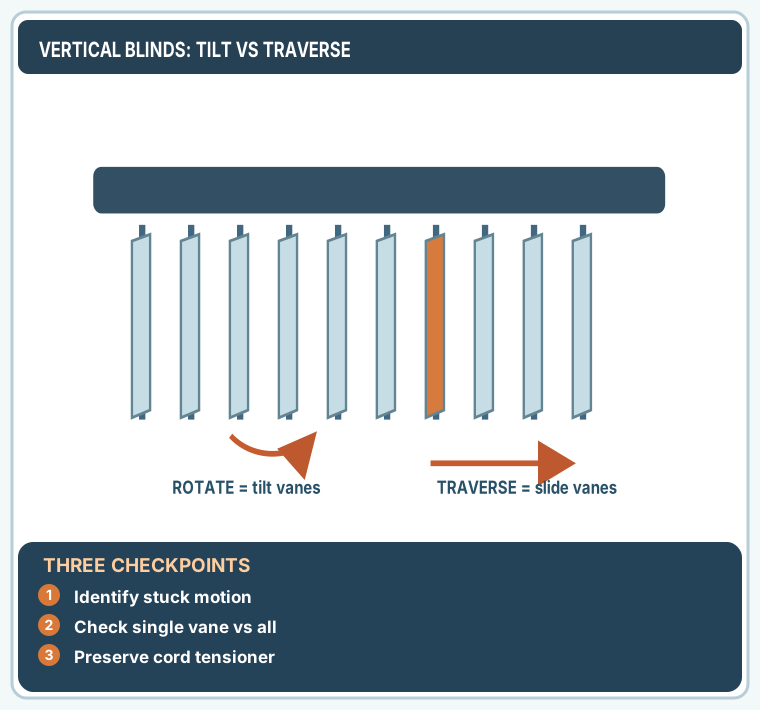
Open desktop diagram ↗ Open mobile diagram ↗
Read the diagram: three checkpoints
- Identify stuck motion
- Check single vane vs all
- Preserve cord tensioner
Vertical blinds have two distinct motions: their vanes rotate to control light, and the vanes traverse sideways to stack. A blind that opens across the door but won't rotate is different from a blind whose cord moves yet the carrier train refuses to travel. The first task is to separate rotation from traversal without forcing the controls or exposing children to hazardous cord loops.
Fast symptom test: rotation or traversal?
From the normal operating position, check with gentle force whether the slats hang parallel and whether the track can open/close. Do not force a stuck beaded chain or pull the cord harder. Record which motion fails and whether it happens for every vane or only one.
On a narrow screen, scroll this table sideways to see every column.
| Symptom | Likely inspection target | Do not assume |
|---|---|---|
| All vanes traverse but none rotate | Tilt control/drive rod or jam | A new vane fixes it |
| One vane is 90° different | Individual carrier alignment or vane attachment | Entire headrail is defective |
| Vanes rotate but won't slide | Traverse mechanism, carrier obstruction | Tilter is the problem |
| Plastic vane hook broken | Specific carrier stem/hook | Generic clip will fit |
| Control chain/cable is loose or tangled | Tensioner, safety device, product design | Cutting the loop is safe |
Blinds.com's vertical blind repair guide treats tilt and traverse as separate faults and describes vane removal and alignment operations for particular products. Your exact unit may be different.
Identify the blind before any headrail repair
Photograph the headrail end caps, wand or chain operator, track cross-section, carrier stems and manufacturer label. A vertical blind with a wand may use a combined traverse/tilt mechanism. A split-draw unit carries vanes to both sides, while a one-way draw stacks on one side. Do not apply a corded-headrail procedure to a wand design or proprietary motorized control.
Compare the exact installation diagram and any compatible replacement parts list. If the blind was recently installed, check whether the headrail clips are fully seated and a valance or end stop blocks a carrier.
Simple external checks with the lowest risk
- Move furniture and window hardware away from the vane path.
- Check whether each vane hangs freely or collides with the sill, flooring or neighboring vane.
- If the maker permits it, rotate vanes toward their fully open position before traversing.
- Look for a single torn or twisted vane that is catching the carrier directly above.
- Check whether the safety chain/cord tensioner is securely installed and intact; do not disconnect it for convenience.
- Stop if the control requires unusual force or an end cap is loose.
For a correctly installed system with only one vane misaligned, read the specific manual’s carrier synchronization method. Some systems can be realigned by completing a rotation sequence; others need a replacement carrier and will break if forced.
One manufacturer repair guide separates the two control-end faults
Blinds.com's vertical-blind repair guide provides different possible mechanisms for a difficult rotation chain versus a blind that will not traverse sideways. These are examples from its supported headrails, not safe universal disassembly steps.
On a narrow screen, scroll this table sideways to see every column.
| What fails during normal, gentle use | The specific mechanism discussed in the Blinds.com guide | Homeowner-safe next action |
|---|---|---|
| Vanes move sideways but chain-driven rotation is difficult | At the control end, a pulley/drive rod and a star-shaped push nut can contribute to binding on certain designs | Photograph control type and end-cap label. Do not knock the rod, loosen a push nut or remove an end cap without the exact model instructions and safe access |
| Vanes rotate but the group will not traverse | The guide describes a nylon cord at a pulley on the end opposite the chain/cord controls on a particular cord-operated headrail | Check for visible external obstruction only. Do not reroute a control cord, release a cord tensioner or open a mechanism based solely on this example |
| Just one vane hangs crosswise | Carrier stem, vane hook or synchronization of that unit may differ from a full control failure | Photograph one failing carrier against two working neighbors; consult the maker before twisting or unclipping |
| Wand-operated or motorized headrail | These cited chain-and-cord internals may not exist | Use the exact model's operator/manual and disconnect or isolate power only as its instructions require |
Why this prevents a wrong repair: a headrail that traverses normally but fails to rotate does not justify replacing the traverse cord. Likewise, a carrier train that will not traverse cannot be repaired reliably just by forcing the tilt chain. Record the two outcomes separately before asking for a part.
Cord safety boundary: the same retailer's page discusses internal cord and tensioner work for certain designs. That is not a general invitation to modify an exposed loop in a home with children. Preserve the original safety device and follow current applicable requirements; ask for a compliant product-specific solution instead of improvising a cord fix.
Worked diagnostic scenario
Suppose you have 12 vanes, 11 rotate together and the twelfth remains crosswise. That points toward one carrier or vane attachment rather than a full-system tilt failure. If instead all twelve resist movement and the chain binds immediately, investigate a control-end problem with the maker. Numbers are illustrative, not a manufacturer test method.
Save the count, the control type, and whether rotation or traversal fails in your project notes; these details make a repair request far more specific than “blinds stuck.”
Five observations that identify whether a vane, carrier or control is failing
Do the checks from the normal operating position, with the blind safely supported and no fingers inside the moving headrail. This is an observation checklist, not permission to disconnect a cord or open a control assembly.
On a narrow screen, scroll this table sideways to see every column.
| What happens when you use the control gently? | Component to inspect | Decision before buying |
|---|---|---|
| One vane stays 90° out while the others rotate evenly | That vane's hanger and its individual carrier orientation | Compare an undamaged matching vane; see vane replacement fit |
| All vanes refuse to tilt but can traverse normally | Tilt-control operator, gear/rod, obstruction | Identify wand/chain design and the exact model's authorized service procedure |
| Vanes tilt normally, but the complete stack fails to move sideways | Traverse cord/pulley/carriers and a physical obstruction | Do not buy a new tilt mechanism because traversal fails |
| One carrier breaks with a visible sharp plastic tip | Exact hook/stem geometry, serial/model and replacement carrier list | Don't substitute a generic vane clip or place extra load on the next carrier |
| Chain or continuous loop is loose or reaches a child | Tensioner or other approved cord-safety device | Stop operation and use manufacturer/CPSC compliant service, not a bypass |
Blinds.com's repair instructions themselves have separate sections for vane misalignment, stiff rotation and opening/traverse problems. Some of those sections describe opening an end cap or altering a tensioner; these instructions are product-specific and not suitable to generalize to an unrecognized blind. Use a manufacturer's named service manual or a qualified technician for internal hardware.
Write the service request that gets the right part
Record control type (wand, chain, motor), stack direction, approximate number of vanes, whether the failure is one/all, whether tilt/traverse is affected, and a legible headrail label. Photograph a good neighboring carrier and the failed position from the same angle. A seller can then distinguish a replacement vane, carrier stem, tilt control end or entire headrail before quoting one.
After a model-approved repair, run slow separate tests: first rotate vanes without traversing, then traverse with the vanes positioned as the maker requires. If the chain pulls hard, one carrier clicks over a stop, a bracket becomes loose, or a cord-safety device no longer functions, the repair has failed the safety/operation check. Do not force an additional cycle.
Why internal repairs require the exact instructions
Blinds.com's repair content describes some pulley, star-washer and cord-tension operations; those relate to particular hardware designs. Opening an unrecognized mechanism or pulling on a looped cord can create safety hazards and damage. Do not attempt a generic headrail disassembly from this article. The correct replacement might be a wand tilter, control-end mechanism, gear, carrier stem or a complete headrail, but the part can only be selected from the product series and observed failure.
If you see exposed cord loops, a detached tensioner, sharp broken plastic or loose ceiling mounts, discontinue use and seek the original manufacturer's service process.
Verify rotation and travel after a model-approved repair
Operate the vanes gently through their intended rotation, then traverse the full permitted distance. Look for evenly spaced vanes with no hanging clips, crossed stems, dragging fabric or failure to close across the opening. Run several slow cycles and record if a fault recurs at the same position.
When a vane itself is broken, see replacement vertical blind vanes instead of dismantling the operator.
Evidence-backed safety triage: use the right authority
A blind that will not tilt is not just a mechanical puzzle. The U.S. Consumer Product Safety Commission's window-covering advice identifies accessible cords and loops as a child-strangulation hazard; it recommends cordless coverings when young children are present. The UK Office for Product Safety and Standards separately explains fitted tensioners and cleats for corded systems. Those are country-specific safety references, not permission to modify an unknown control system. Never loosen, bypass or shorten a safety device just to make the vanes move.
On a narrow screen, scroll this table sideways to see every column.
| Observe without opening the headrail | What the observation helps separate | Next step |
|---|---|---|
| All vanes slide sideways but none tilt | Traverse path works; tilt drive or a jam may be involved | Record manufacturer/model and consult the exact tilt-control instructions |
| One vane hangs at an unusual angle | Individual hanger or carrier position | Check whether a model-approved vane reseating procedure exists |
| Every vane tilts but the stack will not traverse | Traverse path or obstructions, not necessarily the tilter | Stop forcing the control and request product-specific repair instructions |
| Chain tensioner is absent, loose or accessible to children | Immediate child-safety concern | Stop use and seek a compliant repair or cordless replacement |
Before requesting a replacement part: photograph the entire headrail from a safe position, the end-cap label, the control type and the single failed vane or operator. Write down whether the same fault occurs when tilting and traversing separately. The Blinds.com vertical-blind repair reference documents that distinction for its supported designs, but a generic online part cannot be assumed to fit yours.
Sources and scope limits
- Blinds.com: Vertical blinds repair.
- Blinds.com: Vertical blind installation and operation.
- Blinds.com: General blinds and shades repair index.
MendNook has not tested your tilt drive. This is a research-based diagnostic guide; manufacturer and child-safety instructions override generic advice.
After the project: did it work?
After completing only product-approved work, document what you actually observe instead of assuming a replacement part resolved the fault.
- Success looks like
- All vanes rotate and traverse through their normal range without crossing, binding or stressing cord-safety devices.
- If it still fails
- If one carrier skips or control binds, stop forcing the mechanism and identify model-specific tilter/carrier service.
- Keep for next time
- Control type; affected vane count; rotation/traverse test; missing part
Keep your actual measurements and observed result in your private project notebook. This is a verification checklist, not a product certification.
My project record: progress and take-home checklist
Select a progress stage if helpful. This is a personal record only, not a claim that MendNook verified your repair.
Includes this guide's specific diagnosis, decision, safety, and outcome checks, plus any note entered above. Nothing is sent to MendNook; downloads and copy operations stay under your control.