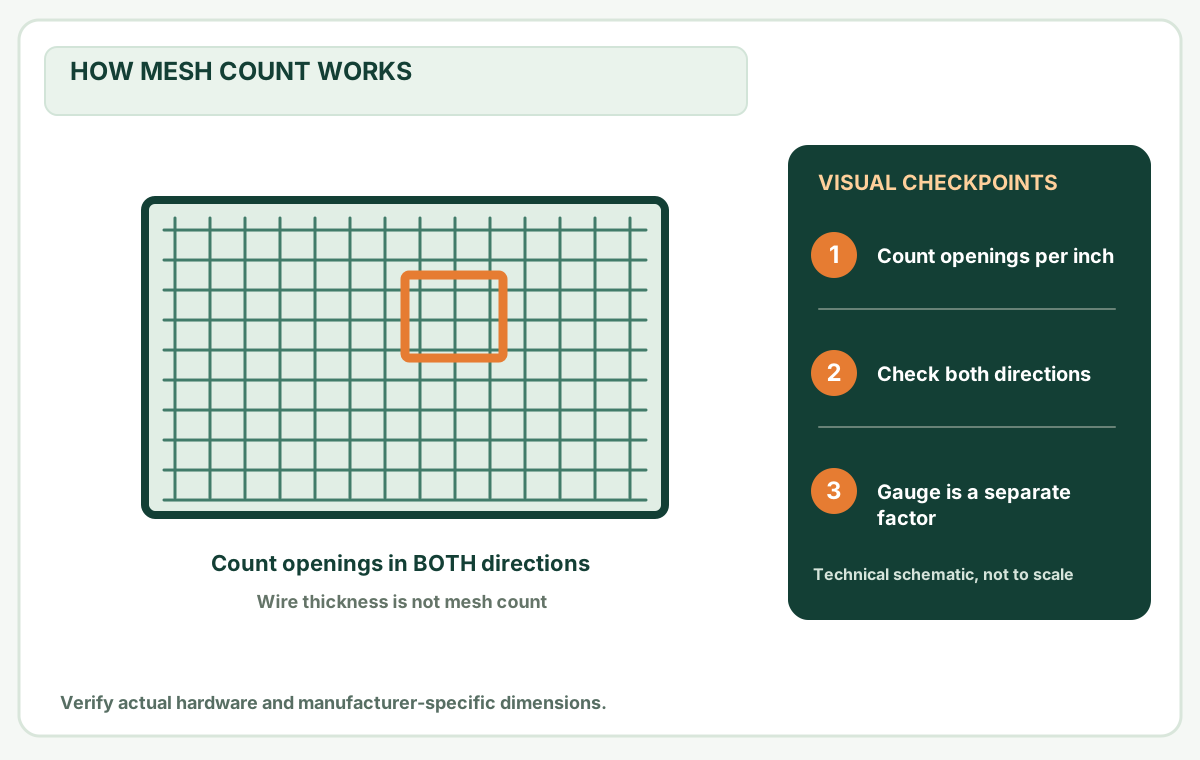
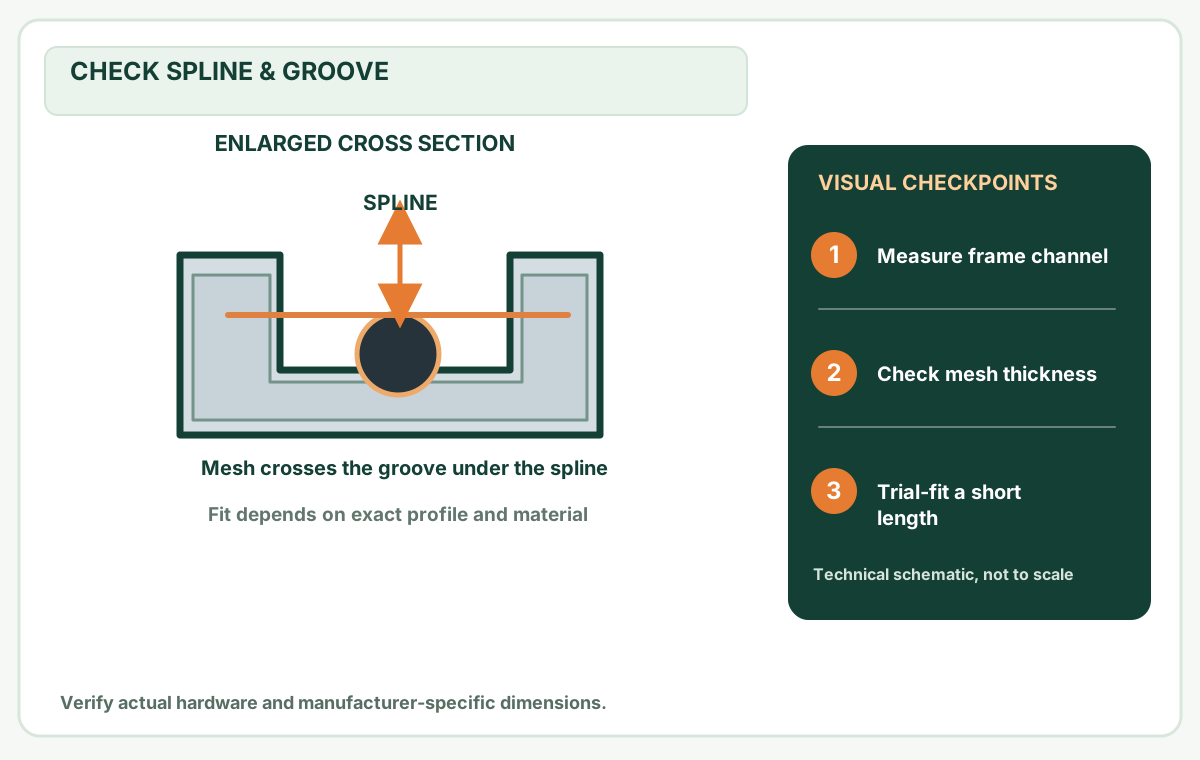
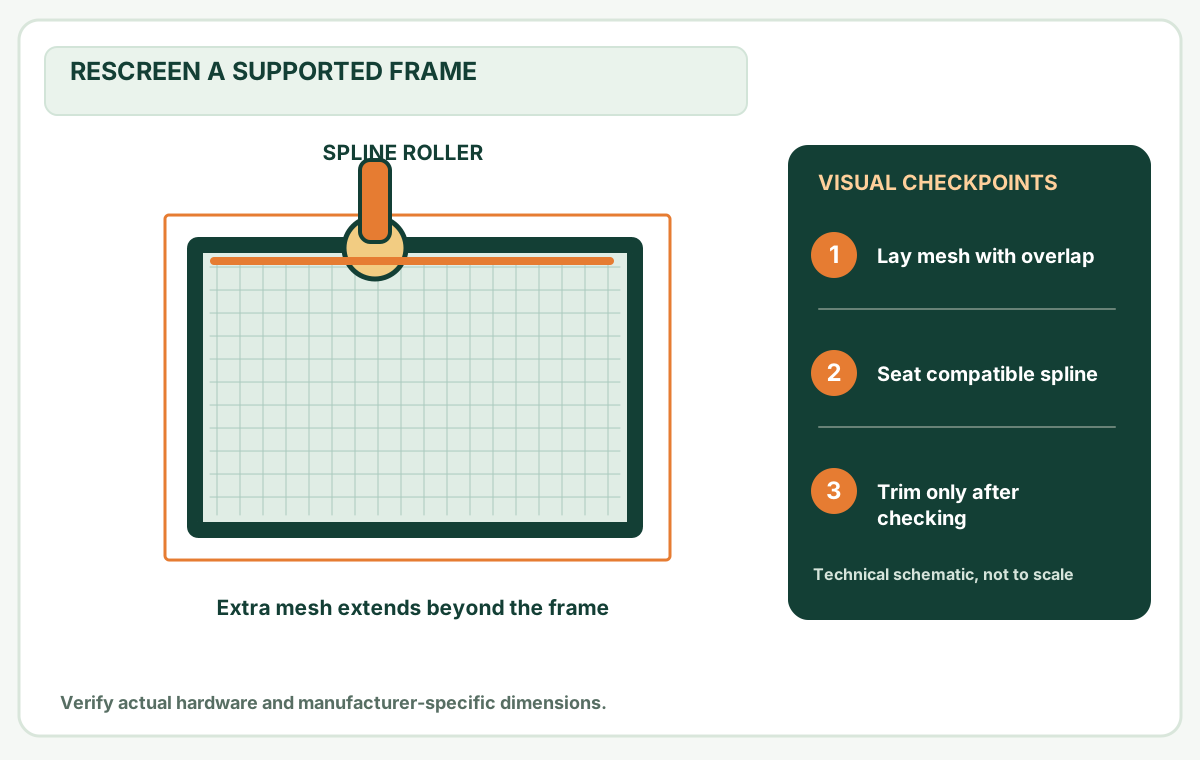
Choose mesh based on the application and compatible frame channel; thicker mesh can change the required spline size.
Before you buy or repair
- Record first
- Intended use: basic insects, small insects, pets, sun or durability
- Make the decision
- Specific mesh product data, profile fit and compatible spline before cutting a full roll
- Stop & verify if
- A marketing name is mistaken for a tested performance guarantee or compatible fit
Jump to a section
- Diagram checkpoints
- Quick comparison
- Choose by the failure you are trying to avoid
- Compare a real manufacturer combination, not a generic “best mesh” score
- Fiberglass: a flexible default
- Aluminum: more rigid handling
- Pet-resistant screening
- Product and color availability: a real PetScreen buying exception
- Solar screening and no-see-um mesh
- Compare two candidate products before committing to a full roll
- Three decisions to make before comparing prices
- Screen selection worked comparison: match the problem before the material
- Choose a repair workflow after the material decision
- References
- After the project: did it work?
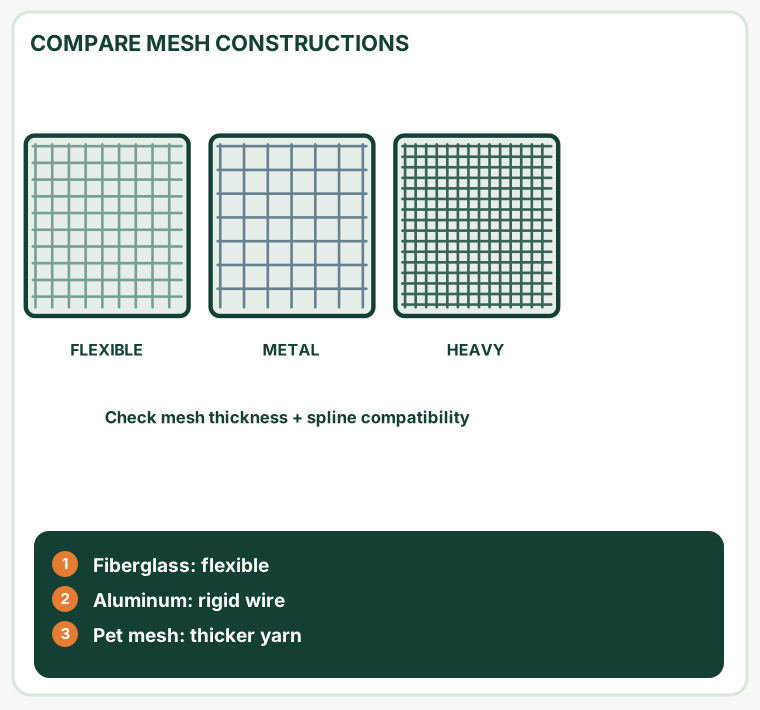
Open desktop diagram ↗ Open mobile diagram ↗
Read the diagram: three checkpoints
- Fiberglass: flexible
- Aluminum: rigid wire
- Pet mesh: thicker yarn
Choosing screen mesh is about the room and the actual frame, not just the price of a roll. Fiberglass, aluminum and pet-resistant screening can all keep insects out, but they behave differently when installed and used.
Quick comparison
On a narrow screen, scroll this table sideways to see every column.
| Material | Typical reason to choose it | Things to watch |
|---|---|---|
| Fiberglass insect mesh | Flexible general-purpose replacement for many ordinary windows | Can be punctured or torn with rough contact |
| Aluminum insect mesh | Rigid-feeling mesh that holds shape reasonably well | Can crease or dent if bent; metal edges may be sharp |
| Pet-resistant mesh | Higher resistance to scratches and claw contact | Often thicker; check spline size and airflow/visibility |
| Solar screen fabric | Intended to reduce sunlight or glare in certain installations | Different openness, darkness and spline requirements |
These are broad material trade-offs, not tested numerical ratings. Products and weave types vary significantly. Check the manufacturer's published specifications when you need precise openness, shade percentage or strength data.
Choose by the failure you are trying to avoid
On a narrow screen, scroll this table sideways to see every column.
| Priority | What to compare | Important tradeoff |
|---|---|---|
| Keep typical flying insects out | Standard fiberglass or aluminum insect-screen products | Handling, visibility and repair method differ |
| More resistance to pet claws | Manufacturer-labeled pet-resistant screening | Material may be thicker and require different spline |
| Reduce glare/solar gain | Documented solar-screen performance for the exact material | Light, visibility and airflow may change |
| Exclude very small insects | Finer insect-screen constructions with published specs | Open area and ventilation may fall |
Product-fit workflow: Identify your frame profile and available mesh roll width, then check the screening maker's installation instructions. Do not purchase based on an “all-purpose best mesh” list: a thicker pet screen may fit a standard groove only with a different spline, and a solar screen may change indoor light levels.
Two-room scenario: A bathroom where airflow matters and a sun-facing room where glare matters do not have identical requirements. Write down the primary problem for each opening, then compare material specifications separately. One mesh choice for the whole home is convenient, but not always the best fit.
Compare a real manufacturer combination, not a generic “best mesh” score
Phifer's published screen-and-spline chart illustrates a compatibility detail easy to overlook. For one named 5/16 × 3/4-inch frame profile, it lists 0.140-inch spline with standard fiberglass insect mesh but 0.125-inch spline with PetScreen/TuffScreen. These are recommendations for the specified frame and products, not a rule for every pet-resistant screen on the market.
On a narrow screen, scroll this table sideways to see every column.
| If you're changing… | Confirm before buying | Why it matters |
|---|---|---|
| Fiberglass to pet-resistant mesh | Actual frame profile, channel size and new spline specification | Thicker mesh occupies more of the retaining groove |
| Ordinary mesh to a fine-insect product | Manufacturer's insect-use statement, product dimensions and roll width | Mesh count by itself is not an insect-performance test |
| Ordinary mesh to a solar product | Installation orientation, light reduction specs and screening system | A product sold for solar screening may have different fit and handling rules |
| Mesh in a visibly distorted frame | Frame straightness, corner retention and mounting hardware | New material cannot correct a twisted or loose frame |
Ordering rule: first identify the actual problem (insects, pet damage, light or a torn panel). Then choose a named mesh product, find its technical instructions, measure the frame channel, and finally confirm a compatible spline. Buying the “strongest” roll before checking the existing groove can make an otherwise straightforward repair fail.
Fiberglass: a flexible default
Ordinary fiberglass insect screening is a common material for home screen repairs because it is flexible to handle and easier to work with around a frame groove. It is appropriate when insect exclusion and an unobtrusive look are the main goals and the screen is not frequently pushed or scratched.
Consider fiberglass when the frame is in good condition, the old screen used standard mesh and there is no reason to switch material types. Even then, verify that the spline you intend to reuse fits the new mesh.
Aluminum: more rigid handling
Aluminum screening may appeal when you want a metal mesh. The wire retains creases once sharply folded, however, so cutting and rolling it call for care. Watch for sharp cut edges, and do not assume the same handling technique or spline used for fiberglass will suit every frame.
If the window maker recommends a specific screening material, follow that requirement rather than substituting based on general appearance.
Pet-resistant screening
Pet-oriented mesh is usually thicker or differently constructed than ordinary fiberglass screening. That extra thickness can reduce the free space in the spline groove, potentially requiring a smaller spline size with some frame/material combinations.
It is not a substitute for a secure safety barrier: screens are generally not intended to prevent falls or restrain children or animals. Never rely on an ordinary insect screen as a fall-prevention device.
Product and color availability: a real PetScreen buying exception
Published manufacturer dimensions are more useful than a generic claim that "pet mesh is stronger." Phifer's current PetScreen DIY product page lists the following standard retail widths, with a crucial color restriction.
On a narrow screen, scroll this table sideways to see every column.
| Requested material | Published width family | Color-specific restriction | What you should check |
|---|---|---|---|
| Phifer PetScreen | 30, 36, 48, 60 in | Product lists Black and Grey colors for the standard group | Confirm the exact width, color, length and product number are combined in the item being sold |
| Larger Phifer PetScreen | 72 and 96 in | The manufacturer specifically lists these sizes in Black only | Do not assume a 72-in gray roll is a standard available SKU |
| Phifer Standard Fiberglass DIY | Manufacturer lists widths 24 to 96 in | Different product and composition from PetScreen | Check the precise width and color in the standard fiberglass listing rather than transferring PetScreen restrictions |
| PetScreen or TuffScreen in a 5/16 x 3/4-in frame | Phifer sizing chart lists 0.125-in spline | The same chart lists 0.140-in spline for standard fiberglass in that named frame | A change in fabric type can change the retainer size; verify the actual groove profile, not just the fabric thickness |
Worked shopping case: A homeowner wants gray pet-resistant mesh for a wide panel whose temporary handling blank must be 72 in across the roll. In Phifer's published standard width table, the 72-in PetScreen option is Black only, not gray. The correct next step is to ask the supplier for a documented alternative product or configuration; buying a narrow gray roll and inventing a seam is not a supported single-panel installation.
Second case — enough area, wrong width: An illustrative temporary 40 x 80-in fabric blank requires 3,200 square inches. Suppose the available hypothetical stock is 36 in wide with 100 in of usable length: its 3,600-square-inch area is greater, yet neither 40 nor 80 in can be placed across the 36-in roll width, so one intact blank cannot fit. By contrast a hypothetical 48-in-wide roll with 84-in usable length passes the bare width/length geometry check (40 across and 80 along), but only if that exact width/length/color product is sold and the mesh maker permits the required orientation. Confirm the actual SKU and usable roll width rather than treating separate width and roll-length lists as evidence that every pairing exists.
User safety boundary: Pet-resistant fabric is still insect screening, not a rated safety screen, child-fall guard, pet barrier or restraint assembly. Stronger marketing claims do not replace appropriate physical fall protection.
Solar screening and no-see-um mesh
Solar meshes are designed to change the amount of sunlight entering through the screen; dense insect meshes target smaller insects. In either case, more fabric can affect visibility and airflow. Match the product to the room's goal and to the frame's capacity.
For specialty fabrics, Phifer's sizing guidance distinguishes standard and thicker products rather than treating every spline-and-mesh combination as interchangeable.
Compare two candidate products before committing to a full roll
A general-purpose fiberglass screen and a specialty fine-insect or pet-resistant mesh can both be appropriate, but comparing price alone misses the costly parts of a failed installation. Create a one-row record for each candidate:
On a narrow screen, scroll this table sideways to see every column.
| Check | Candidate A | Candidate B |
|---|---|---|
| Exact manufacturer and product line | Record from label | Record from label |
| Mesh roll width versus required cut width | At least the required cut width | At least the required cut width |
| Published groove/spline compatibility | Exact chart cell or supplier confirmation | Exact chart cell or supplier confirmation |
| Relevant goal | Insects / pets / sun / visibility | Insects / pets / sun / visibility |
| Unverified claim you must confirm | Leave blank until documented | Leave blank until documented |
Example: A person replacing a torn standard insect screen may not need to change material at all. A homeowner with repeated claw tears may consider pet-resistant mesh, but should first check that the thicker fabric and specified spline fit the existing frame. Phifer's spline selection chart lists material-dependent combinations, including cells left blank for some frames. A blank cell is a reason to verify, not permission to improvise a size.
Three decisions to make before comparing prices
If the problem is very small insects: Phifer identifies its 20×20 fiberglass No-See-Ums screen as a fine-insect option. That is not a measured claim that all 20×20 products will perform identically. Compare the target insect, actual opening size and the perimeter fit of the installed frame; tears and gaps can defeat a denser weave.
If the problem is pet claws: compare the specific named fabric and its stated compatibility with your frame. Phifer's chart lists some thicker materials with a smaller spline diameter than standard fiberglass for certain frame profiles. A product being tougher than standard mesh does not make it a fall-prevention barrier.
If the problem is visibility or solar exposure: obtain the manufacturer’s openness, shade or light-transmission figures for the exact material. Neither color nor thread count alone gives a universal airflow percentage. Compare like-for-like published test methods before declaring one product “best.”
Screen selection worked comparison: match the problem before the material
Suppose two windows share the same frame profile. Window A has ordinary fiberglass that tore during cleaning; Window B faces frequent pet contact. Reusing fiberglass may be reasonable for A after checking the frame, but B may call for a manufacturer-listed pet-resistant construction. That does not mean buying the thickest mesh and reusing the same spline.
Phifer's first-party sizing chart gives an instructive pair for a 5/16 × 3/4-inch frame: 0.140-inch spline with ordinary fiberglass, versus 0.125-inch with the maker's listed PetScreen/TuffScreen construction. Aluminum is also listed at 0.125-inch for that particular combination. These are specific chart cells, not universally safe substitute sizes. A different manufacturer, channel or mesh system requires a separate check.
Record (1) actual groove/profile, (2) named mesh product, (3) published spline pairing, (4) intended use and (5) whether a short test fit holds without distorting the frame. If any of the first three is unknown, request a manufacturer match instead of presenting a speculative mesh recommendation as proven.
Safety boundary: insect screens are not fall-prevention guards. The CPSC's home childproofing guidance warns that window screens do not prevent children from falling. Do not leave an elevated screen unsecured or assume sturdier mesh makes the opening safe.
Choose a repair workflow after the material decision
A material comparison is useful only when it leads to the right next task. Use the actual condition of the panel, not the sales category:
On a narrow screen, scroll this table sideways to see every column.
| What you have found | Better next guide or tool | Why it is the correct next step |
|---|---|---|
| One small tear, good frame, otherwise sound mesh | Patch torn window screen | Compare fiberglass adhesive versus hooked-metal patch methods before buying a full roll |
| Widespread rips, sound frame and removable round spline | Rescreen with fiberglass | Learn a controlled supported-frame installation; verify a different method for aluminum |
| Want to switch from standard mesh to PetScreen or solar | Choose compatible spline and Phifer sizing lookup | A thicker fabric can change the retainer pairing for the actual channel |
| Screen no longer sits squarely or its corner opens | Inspect screen frame alignment | Different screening fabric cannot straighten a structural defect |
| Unsure what 18×16 versus 20×20 means | Understand mesh count and openness | Thread count is not itself a measured airflow or insect-exclusion rating |
Manufacturer source note: Phifer's DIY FAQ and current sizing chart make material-specific distinctions. One general sizing sentence is not a substitute for the actual table cell: the published 5/16 × 3/4 in example lists 0.140 in for standard fiberglass and 0.125 in for aluminum or PetScreen/TuffScreen. These exact examples cannot be generalized to unidentified frames. For a differently configured frame or a chart blank, ask the manufacturer rather than guessing.
After choosing a product: photograph the roll label, confirm the width covers the temporary handling blank, verify the retainer against your actual frame, and keep proof of the exact purchased model. None of this guarantees weatherproofing or safe child/pet restraint; insect mesh is not a fall barrier.
References
- Phifer — PetScreen DIY official widths and Black-only 72/96-in options.
- Phifer — Standard fiberglass DIY roll width range.
- Phifer — Screening and Spline Sizing
- Home Depot — Window Screen Repair
- Phifer — DIY FAQs for screening material and spline differences
After the project: did it work?
After completing only product-approved work, document what you actually observe instead of assuming a replacement part resolved the fault.
- Success looks like
- You have selected a material based on airflow, visibility, durability and exact frame/spline compatibility rather than marketing labels.
- If it still fails
- If a heavy or solar mesh changes retention force or product fit, get the manufacturer's installation guidance first.
- Keep for next time
- Screen purpose; mesh product; frame/groove; spline and compatibility decision
Keep your actual measurements and observed result in your private project notebook. This is a verification checklist, not a product certification.
My project record: progress and take-home checklist
Select a progress stage if helpful. This is a personal record only, not a claim that MendNook verified your repair.
Includes this guide's specific diagnosis, decision, safety, and outcome checks, plus any note entered above. Nothing is sent to MendNook; downloads and copy operations stay under your control.