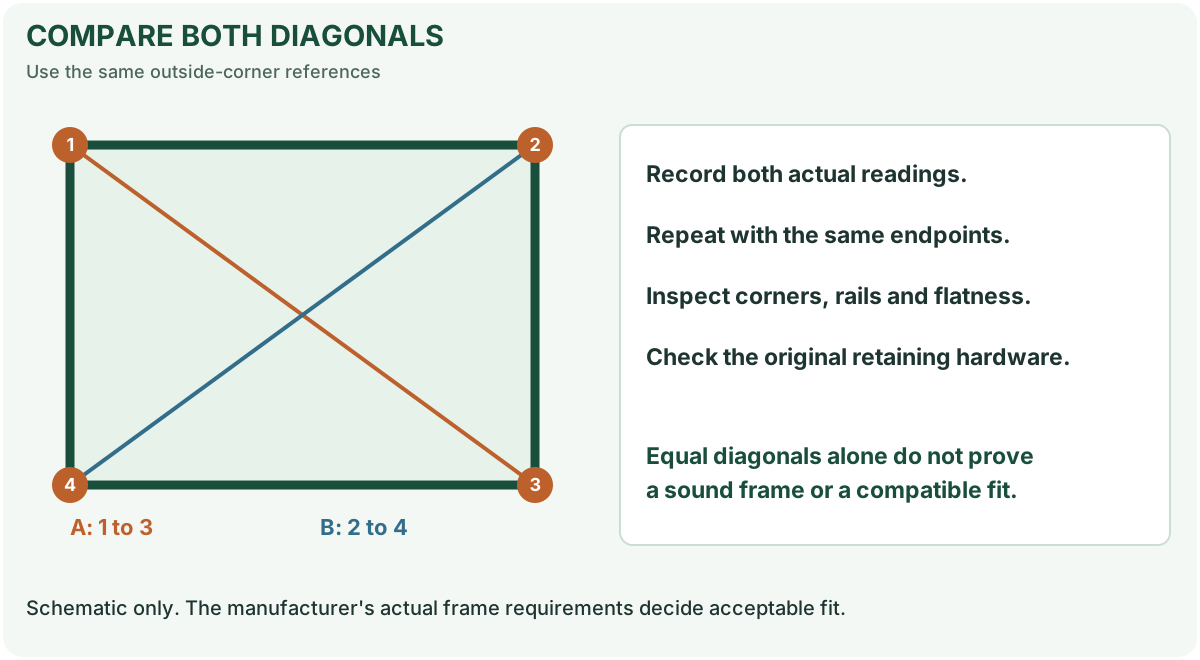
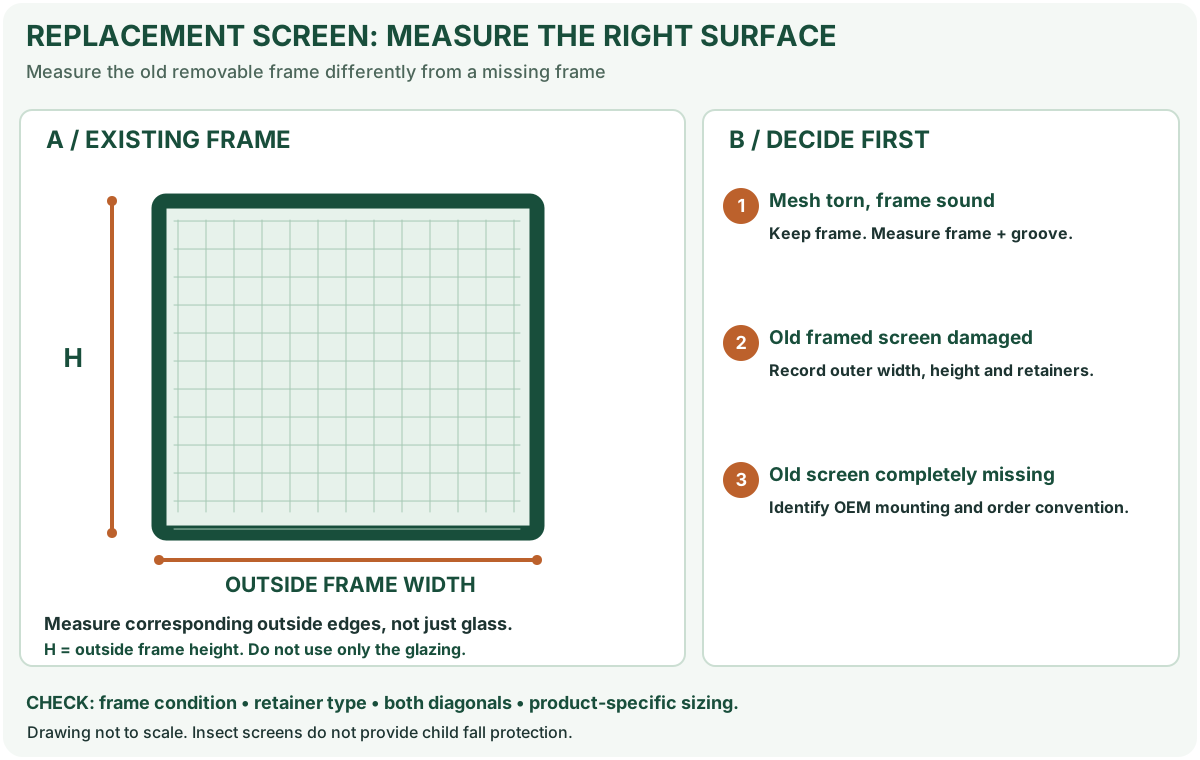
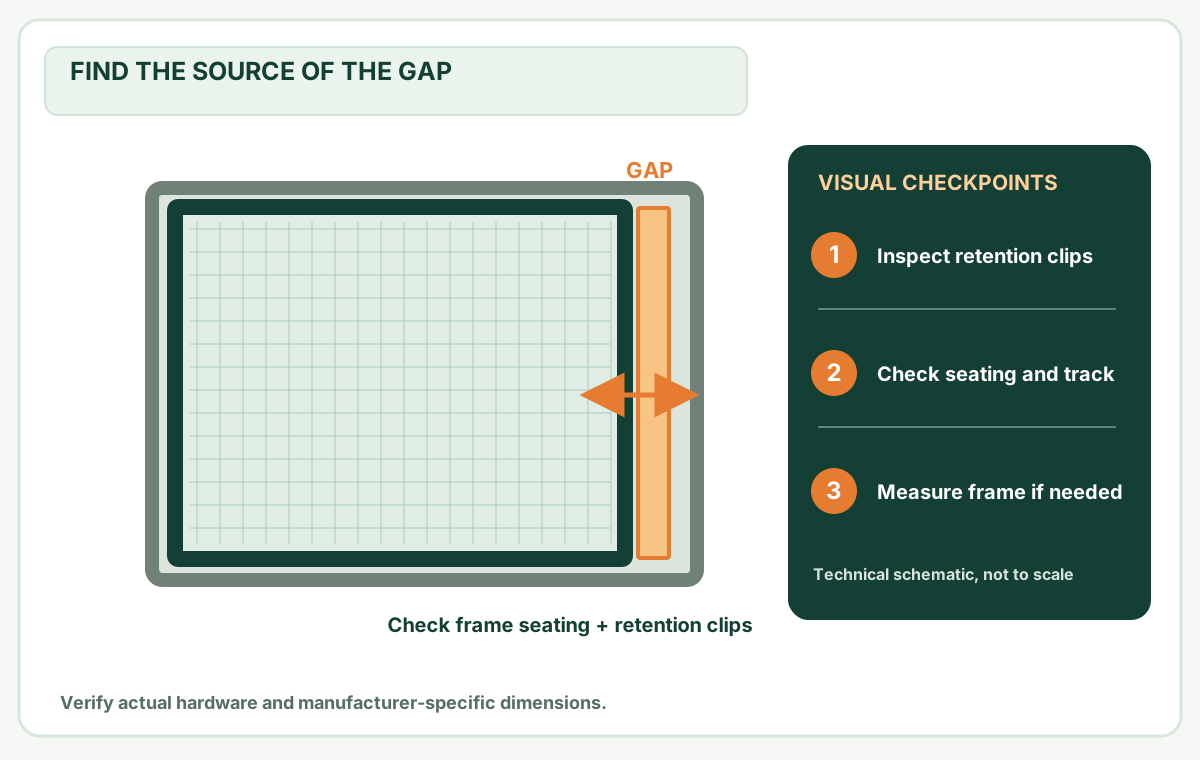
Compare both diagonals and inspect the corner joints. Matching diagonal lengths do not rule out a twisted rail.
Before you buy or repair
- Record first
- Corner joint separation, straightness of each rail and diagonal readings
- Make the decision
- Replacement parts or frame repair based on the actual profile and damage
- Stop & verify if
- The frame is creased, glass/window hardware is involved or force would damage tracks
Jump to a section
- Diagram checkpoints
- Check the fit without forcing it
- Separate a warped frame from a crooked opening
- Inspect each part of the frame
- Check flatness as well as squareness
- Why a DIY straightening attempt can fail
- Before ordering a replacement
- Source-backed distinction: repair the mesh or rebuild the frame?
- A replacement order checklist that prevents the second failure
- Reference
- After the project: did it work?
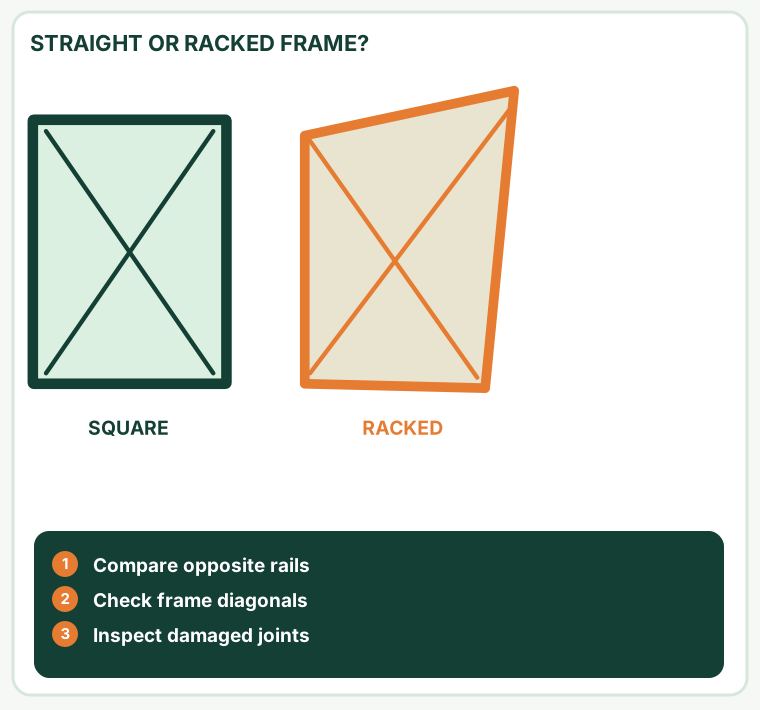
Open desktop diagram ↗ Open mobile diagram ↗
Read the diagram: three checkpoints
- Compare opposite rails
- Check frame diagonals
- Inspect damaged joints
When a window screen does not fit, the mesh may be innocent. A bent rail, separated corner or wrongly sized frame can prevent the screen from sitting correctly even after a careful rescreening job. The key is to establish whether the frame is still structurally sound and fits the intended opening.
Check the fit without forcing it
If the screen jams in the track, remove it using the appropriate release mechanism. Do not bend the frame to make it fit; even a small distortion can cause diagonal wrinkles in new mesh. A screen with failed springs, clips or plungers may look too small or too large when the hardware simply isn't engaging.
Inspect the window's tracks for visible dirt or damage before diagnosing the frame. Take photos of how hardware is mounted if you need to identify replacements later.
Separate a warped frame from a crooked opening
A screen can catch against the window even when its frame is square; the track itself may be blocked, damaged or misaligned. Compare four observations before choosing a repair.
On a narrow screen, scroll this table sideways to see every column.
| What you observe | Check next |
|---|---|
| Frame sits flat on a table but binds in the window | Look for track debris, bent retainers or misplaced spring hardware |
| Frame rocks on a flat surface | Inspect twisting or bowed rails, not just diagonal length |
| Diagonals differ when checked corner-to-corner | Confirm tape placement and look for loose joints |
| Corners separate under light handling | Assess the corner connectors and whether the frame remains serviceable |
Example: A nominal 30 × 24 in rectangular frame has a calculated diagonal of about 38.42 in. Two measured diagonals of 38.40 and 38.44 in differ by 0.04 in, which may reflect tape placement; two readings of 38.1 and 38.7 in are a much larger mismatch that justifies rechecking the corner geometry. These are illustrations, not universal pass/fail tolerances.
Repair-or-replace boundary: A slightly displaced removable corner may be serviceable; fractured plastic corners, permanently bent lineals or damaged channels can require components or a replacement assembly. Never force glass or window hardware to accommodate a distorted frame.
Inspect each part of the frame
Look for four common issues:
- Rails: A kink, twist or sharp bend can prevent flat mesh installation. Minor surface scratches are different from a rail that has changed shape.
- Corners: Corner keys and joints should hold the rails together without visible separation. A loose corner can make the frame rack under mesh tension.
- Spline groove: A crushed or split groove may not retain mesh, even when a correctly sized spline is installed.
- Retaining hardware: Missing lift tabs, clips or spring components may be the real reason for an insecure fit.
Frame materials and corner designs vary. Consult a manufacturer or experienced installer before trying to straighten structural components or replace proprietary parts.
Check flatness as well as squareness
Equal diagonals alone do not prove a screen is serviceable: a twisted frame can still have nearly equal diagonal measurements when the corners are not in the same plane. Put the empty frame gently on a known-flat surface and check whether every corner lies flat without pushing it down. Also inspect all four rail-to-corner connections for movement. If the frame rocks, a rail bows sideways or the joints open during light handling, stop before adding new mesh tension.
Record both diagonals for the maker or replacement supplier. Our frame diagonal calculator gives a theoretical reference; it cannot certify an actual screen frame or the fit of proprietary retaining hardware.
Why a DIY straightening attempt can fail
Lightweight aluminum framing may not return to precise dimensions once sharply bent. Bending it repeatedly can weaken a corner and leave the frame bowed. Screens should not be used as fall-prevention equipment and are not designed to retain a person's weight.
If the window is high, the screen assembly has unusual access, or the track itself is damaged, professional assistance may be appropriate.
Before ordering a replacement
Record the outer dimensions, corner style, frame depth, retention hardware and how the screen sits in the track. Manufacturer guidance matters more than a generic one-size-fits-all clearance rule.
Source-backed distinction: repair the mesh or rebuild the frame?
Home Depot's screen repair guide describes replacing mesh on reusable frames, while separately sold screen frame kits include aluminum rail sections, corner pieces, spline and mounting hardware. This product example proves that corner and rail replacement is a separate repair category; it does not prove the kit fits your window.
Milgard provides different removal/reinstallation guides by screen type, including pull-tab versus lip/finger-pull systems. Even if two old frames have equal width and height, their spring/tab arrangement and installed seating can differ. Use that distinction to avoid ordering a bare rectangular frame that cannot be retained by the original window.
On a narrow screen, scroll this table sideways to see every column.
| Observed defect | Repair path worth checking | Evidence still required |
|---|---|---|
| Frame lies flat, rails straight, mesh torn | Rescreen with suitable material and spline | Correct mesh/groove compatibility |
| Corner key split, rails straight | Replace exact compatible corner key if sold | Key geometry, rail profile, supported fastening |
| One rail sharply kinked or spline channel crushed | Rebuild with matching rails or replace entire frame | Maker-approved dimensions and retaining profile |
| Frame square on a bench but loose in window | Inspect screen-retaining springs/tabs and track seating | Original screen/window product identification |
Do not transfer a 1/4-inch replacement-window opening tolerance to a lightweight insect-screen frame. Different products use different design clearances, and diagonal arithmetic by itself cannot show whether a twisted or insecure panel is safe to reinstall.
Before buying a frame kit, make a small parts card: window maker/series, actual outside frame dimensions, rail depth/thickness, corner type, original retaining hardware and spline channel. The frame-diagonal tool helps you compare two corner-to-corner readings. It cannot certify compatibility or replace a correctly installed retaining system.
A replacement order checklist that prevents the second failure
A square outline is not the same as a compatible screen assembly. If you have decided the original frame cannot be repaired, ask your supplier to identify the original window series and retainers before interpreting an opening measurement as a new finished frame size.
On a narrow screen, scroll this table sideways to see every column.
| Evidence to send the manufacturer or screen shop | Avoid this shortcut |
|---|---|
| Front and side view of the rail cross-section next to a ruler | Matching only the visible mesh rectangle |
| Four outer frame measurements and both diagonals | Averaging a warped corner into a fictitious “standard” size |
| Photo of the original upper/lower track and spring or tab positions | Buying plain frame sections without the necessary retention design |
| Close-up of corner key shape and damaged spline groove | Ordering any nominally similar corner connector |
| Note of which corner rocks on a supported flat surface | Declaring a twisted frame good because diagonals are equal |
Case example: an old 30 × 24 in framed screen sits properly only while the top spring presses it into the lower track. A new rectangular frame may match both outside dimensions but fail to stay in place if the original compression hardware and insertion path are absent. Confirm the original window-screen retainer system and frame-versus-opening measuring method before placing an order.
Go/no-go result: a screen with sound rails/corners and only damaged fabric may be a mesh-only rescreen. A cracked channel, separated corner or permanently bowed rail needs the maker's compatible structural components or replacement screen. Do not “repair” structural damage by stretching thicker mesh, adding unapproved clips or drilling window drainage surfaces.
Reference
RiteScreen — Screen identification and measurement — compare frame style and hardware before choosing replacement dimensions.
After the project: did it work?
After completing only product-approved work, document what you actually observe instead of assuming a replacement part resolved the fault.
- Success looks like
- The frame is stable, both diagonals and corners were rechecked, and its retaining hardware can hold it securely.
- If it still fails
- If the rail remains bent or a corner joint is damaged, replace or professionally rebuild rather than forcing it into the opening.
- Keep for next time
- Diagonal comparison; damaged corners; fit in opening; replacement decision
Keep your actual measurements and observed result in your private project notebook. This is a verification checklist, not a product certification.
My project record: progress and take-home checklist
Select a progress stage if helpful. This is a personal record only, not a claim that MendNook verified your repair.
Includes this guide's specific diagnosis, decision, safety, and outcome checks, plus any note entered above. Nothing is sent to MendNook; downloads and copy operations stay under your control.