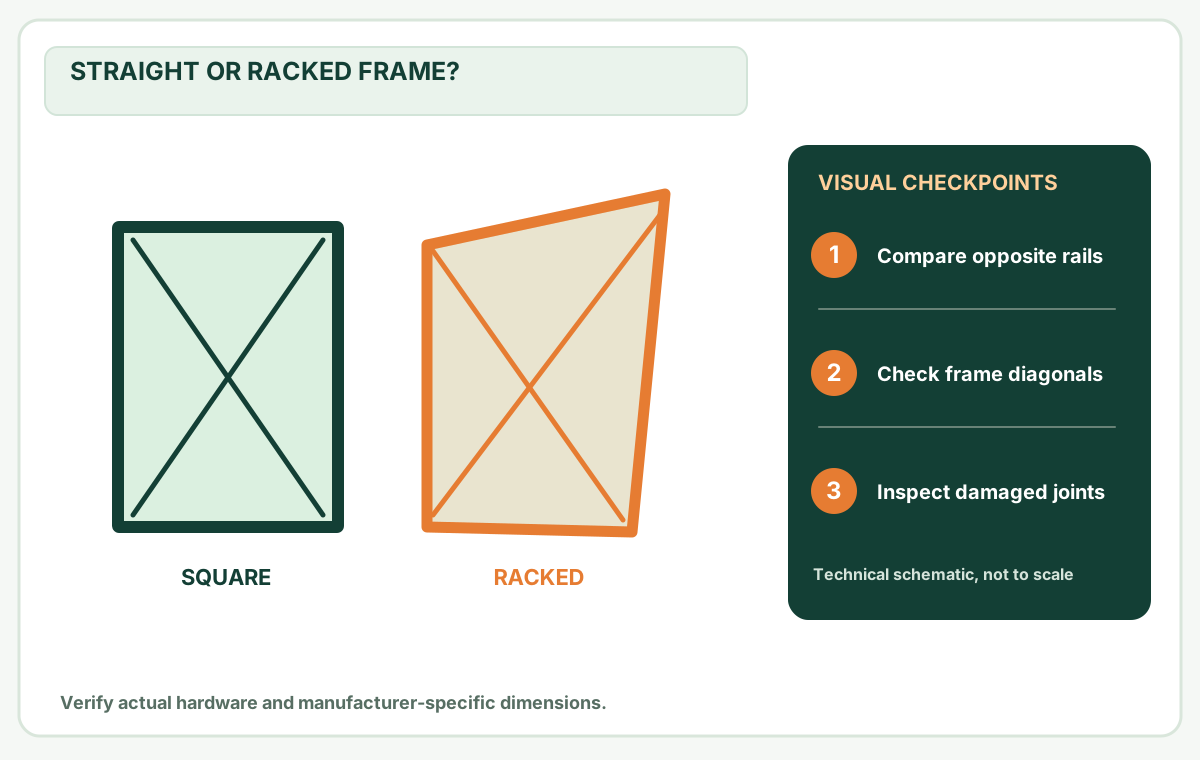
Use both diagonals to detect racking. The theoretical diagonal alone cannot tell you what tolerances your screen manufacturer allows.
Before you buy or repair
- Record first
- Two diagonals on identical corner reference points and both side lengths
- Make the decision
- Compare diagonal difference AND inspect corner joints and bowing
- Stop & verify if
- The panel rocks, a joint separates or the frame is twisted out of plane
Jump to a section
- Diagram checkpoints
- The diagonal method
- What the diagonal test can and cannot prove
- Repeat the readings before interpreting a mismatch
- Other defects to inspect
- When not to pull a frame square
- Before you rescreen
- A worked diagonal check that can be repeated
- Four-case fit decision: squareness is only one dimension of fit
- References and how to apply them
- After the project: did it work?
Open desktop diagram ↗ Open mobile diagram ↗
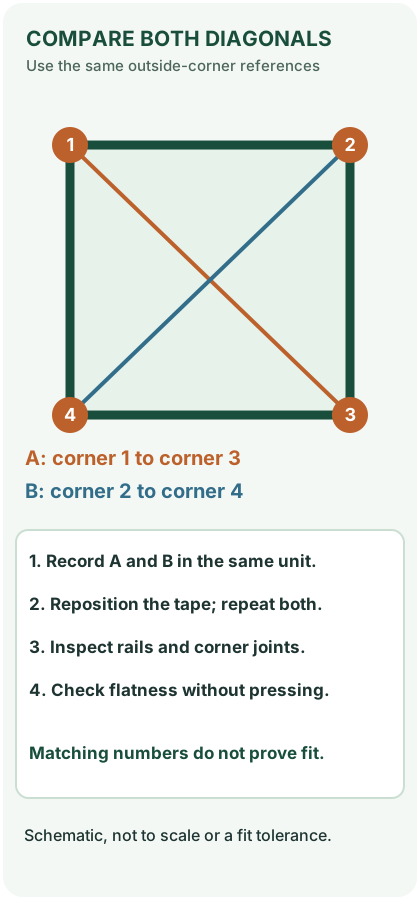
Read the diagram: three checkpoints
- Use matching outer corners
- Record diagonal A and B
- Compare without guessing
A mesh replacement will not fix a screen frame that has twisted or lost its rectangular shape. Before cutting mesh, check the frame on a stable, flat surface. A simple diagonal comparison helps reveal an out-of-square rectangle.
The diagonal method
Lay the empty or intact screen frame flat. Take a tape measure from the outside corner at the upper left to the outside corner at the lower right and record the result. Repeat from upper right to lower left. Try to measure from corresponding points on the same outer frame edge.
For a perfect mathematical rectangle, the two diagonals are equal. For a real frame, tiny differences can result from tape placement and corner shape. Large or repeatable differences suggest the corners are no longer square, though the amount that is acceptable depends on the screen design.
What the diagonal test can and cannot prove
For a rectangle of outside width W and height H, its theoretical diagonal is √(W² + H²). A 30 × 24 in rectangle gives √(900 + 576) = √1476 ≈ 38.42 in. Compare both real diagonals to each other; the formula is a geometric reference, not a manufacturer's fit tolerance.
Use the frame diagonal calculator to compare your own width, height and diagonals; it provides no manufacturer's fit tolerance. A parallelogram-shaped frame may have noticeably different diagonal readings. But equal diagonals alone cannot reveal all twists, bows, loose corners or track interference. Place a removable frame on a flat surface to check whether one corner lifts; use a straightedge along each rail, if available.
On a narrow screen, scroll this table sideways to see every column.
| Measurement pattern | What it suggests | Next check |
|---|---|---|
| Equal diagonals but screen still binds | Track/hardware issue or bow in a rail | Inspect track, clips and frame flatness |
| Unequal diagonals, joints tight | Potential racking or inconsistent endpoints | Re-measure from identical outside corners |
| Unequal diagonals and corner gaps visible | Possibly displaced corner connectors | Look for damaged corners before replacing mesh |
Avoid promising a universal 1/16-in or 1/8-in tolerance. The acceptable fit depends on the actual screen system and maker's installation specifications.
Repeat the readings before interpreting a mismatch
Lift and reposition the tape, then repeat both diagonals from the same outer reference points. A difference that changes between attempts calls for a better setup before diagnosing the frame. For a large frame, ask a helper to steady the far endpoint. Record whether the mesh is installed: tensioned and unloaded frames may differ.
On a narrow screen, scroll this table sideways to see every column.
| Illustrative reading | Diagonal A | Diagonal B | Difference |
|---|---|---|---|
| First placement | 43 1/4 in | 43 1/2 in | 1/4 in |
| Repeat placement | 43 1/4 in | 43 1/2 in | 1/4 in |
This repeatable mismatch justifies inspecting the geometry; 1/4 inch is not a universal screen rejection threshold. These are hypothetical teaching measurements, not results from a MendNook repair. Do not bend a corner merely to make the numbers agree.
Other defects to inspect
- Are the corners fully seated in their joints?
- Is the extrusion bent along an edge?
- Does the frame rock when placed on a reliably flat surface?
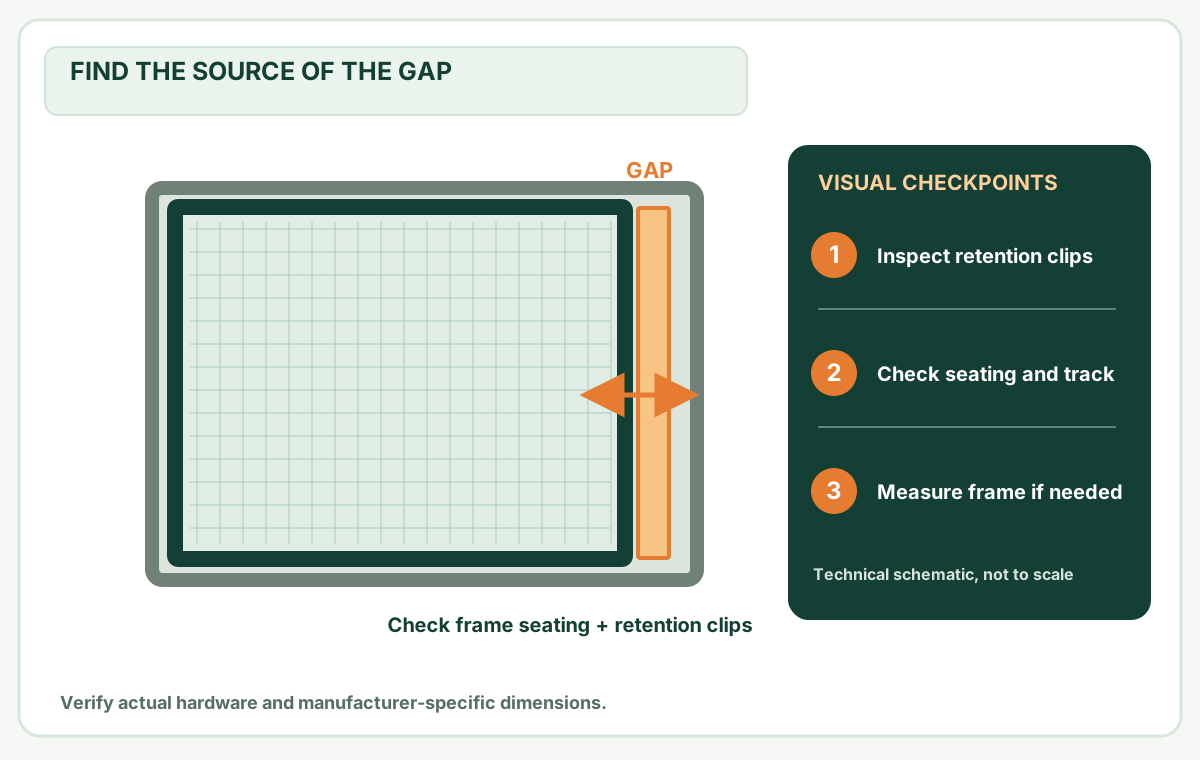
- Are tension clips or hanging hardware missing?
- Does the frame fit the actual window opening without excessive force?
When not to pull a frame square
Forcing a damaged or brittle plastic corner can break it. A badly bowed extrusion may need a replacement part or a completely new frame. Do not apply more mesh tension to compensate for a bent frame: it can worsen deformation.
Before you rescreen
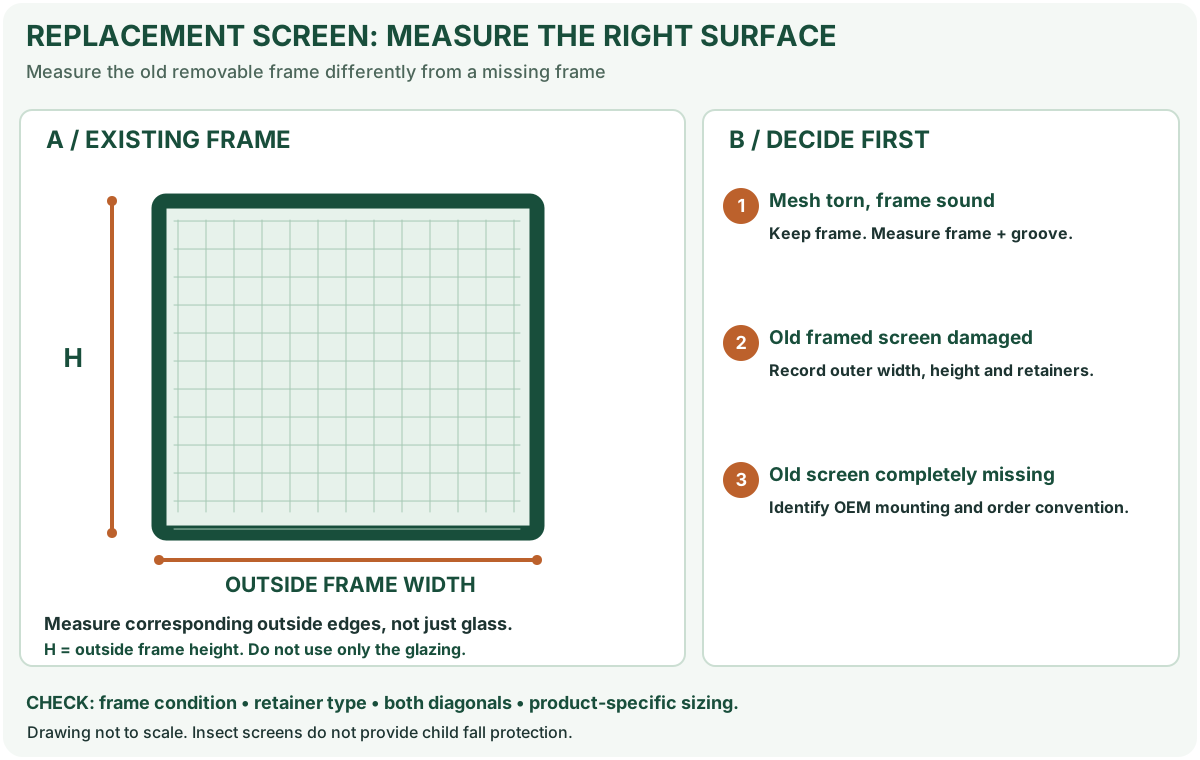
Record both outside dimensions and diagonal lengths, examine joints and hardware, then decide whether the frame is still usable. If the frame is sound, move on to our measuring guide and mesh calculator.
A worked diagonal check that can be repeated
Imagine a rectangular screen frame with an outside width of 24 in and outside height of 36 in. By the Pythagorean formula, its ideal geometric diagonal is sqrt(24² + 36²) = sqrt(1,872) ≈ 43.27 in. This is a mathematical reference only: the real frame may have rounded corners, damage, or reference points that differ from the simplified rectangle. A calculated diagonal is not a supplier-approved replacement size.
Now measure both physical diagonals between the same opposite outer corners:
On a narrow screen, scroll this table sideways to see every column.
| Observation | Interpretation to investigate |
|---|---|
| Both physical readings agree closely, but neither matches the ideal calculation | Check reference points, nominal dimensions and frame profile before concluding the frame is square |
| Diagonals are different | The frame may be racked; inspect corner joints and the fit in the original opening |
| Diagonals agree but a joint is cracked or rails are bent | Equal diagonals do not prove a sound or compatible frame |
Record outside width, outside height, diagonal A, diagonal B and corner condition on the measurement worksheet. Do not force a twisted frame into an opening based on a calculator output. A screen used at an elevated window should be handled from a safe position; the CPSC states that insect screens are not fall barriers.
Four-case fit decision: squareness is only one dimension of fit
Even a precisely measured rectangle may not seat into the window if its original spring or clip arrangement differs. Use the same observations for a screen frame, not a replacement glazed window unit:
On a narrow screen, scroll this table sideways to see every column.
| What is true after two repeat measurements? | More likely next check | Best next guide |
|---|---|---|
| Diagonals repeat and are close, but frame rocks on a flat surface | Twisted/out-of-plane rail or damaged corners | Frame repair versus replacement |
| Diagonals differ repeatedly, rail edges look straight | Loose corner key or racked assembly | Inspect corner connections |
| Diagonals repeat equally and frame lies flat, but it still will not stay in the opening | Missing/incorrect retention springs, channels or existing panel size | Choose the original retainer system |
| Frame is sound and fits the correct original opening, only fabric has holes | No need to order a complete new frame solely for mesh damage | Rescreen existing fiberglass frame |
One useful measurement record includes: outside width at top/bottom, outside height left/right, diagonal A and B (including tape endpoints), flat-surface rocking yes/no, corner integrity and original mounting clips. This is evidence a screen shop can use when a tape number looks plausible but fit is poor.
What repeatability changes—and what it does not
Suppose the first diagonals are 43 1/4 and 43 1/2 in. If a second read is 43 3/8 and 43 3/8 in, the inconsistency suggests measurement setup/endpoint placement deserves a redo before the frame is diagnosed. If the original difference persists across careful checks, record it and inspect the corners. Neither outcome alone establishes a universal rejection threshold.
A reliable comparison uses a supported frame without artificially pushing a corner flat, consistent endpoints and a clear note of whether fabric is tensioned. If the frame already bows or its groove has cracked, adding mesh or a thicker spline is not a fix.
References and how to apply them
- The Home Depot — How to Measure Windows demonstrates measuring opposite diagonals as a general squareness check for window frames. Its product dimensions and window-opening instructions must not be treated as screen-frame tolerances.
- RiteScreen — Guide to measuring replacement screens describes outside-edge frame measurements and measuring twice. The supplier's screen-frame hardware and dimensions remain decisive.
After the project: did it work?
After completing only product-approved work, document what you actually observe instead of assuming a replacement part resolved the fault.
- Success looks like
- Both actual diagonals were measured between matching outer corners and the frame was inspected for twisting or loose joints.
- If it still fails
- If diagonals disagree materially, repeat measurements before deciding whether the frame is repairable; no universal tolerance is implied.
- Keep for next time
- Outside width/height; actual diagonal A/B; visible corner condition
Keep your actual measurements and observed result in your private project notebook. This is a verification checklist, not a product certification.
My project record: progress and take-home checklist
Select a progress stage if helpful. This is a personal record only, not a claim that MendNook verified your repair.
Includes this guide's specific diagnosis, decision, safety, and outcome checks, plus any note entered above. Nothing is sent to MendNook; downloads and copy operations stay under your control.