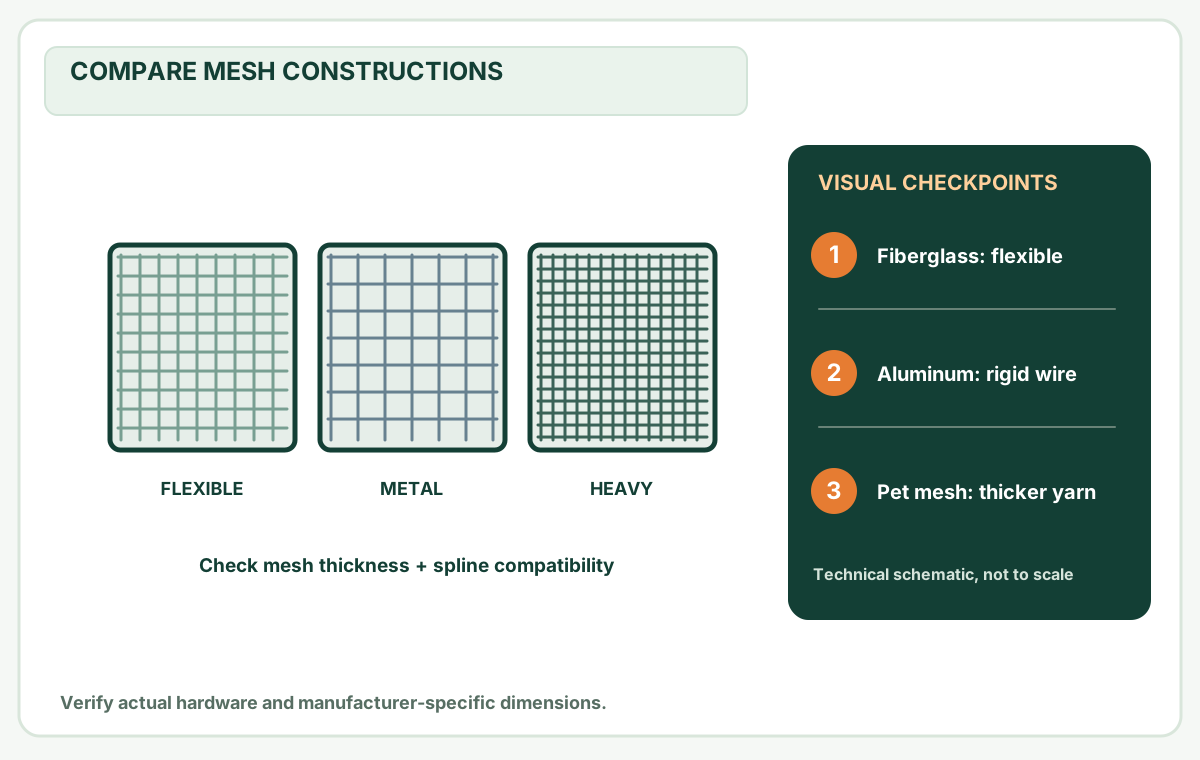
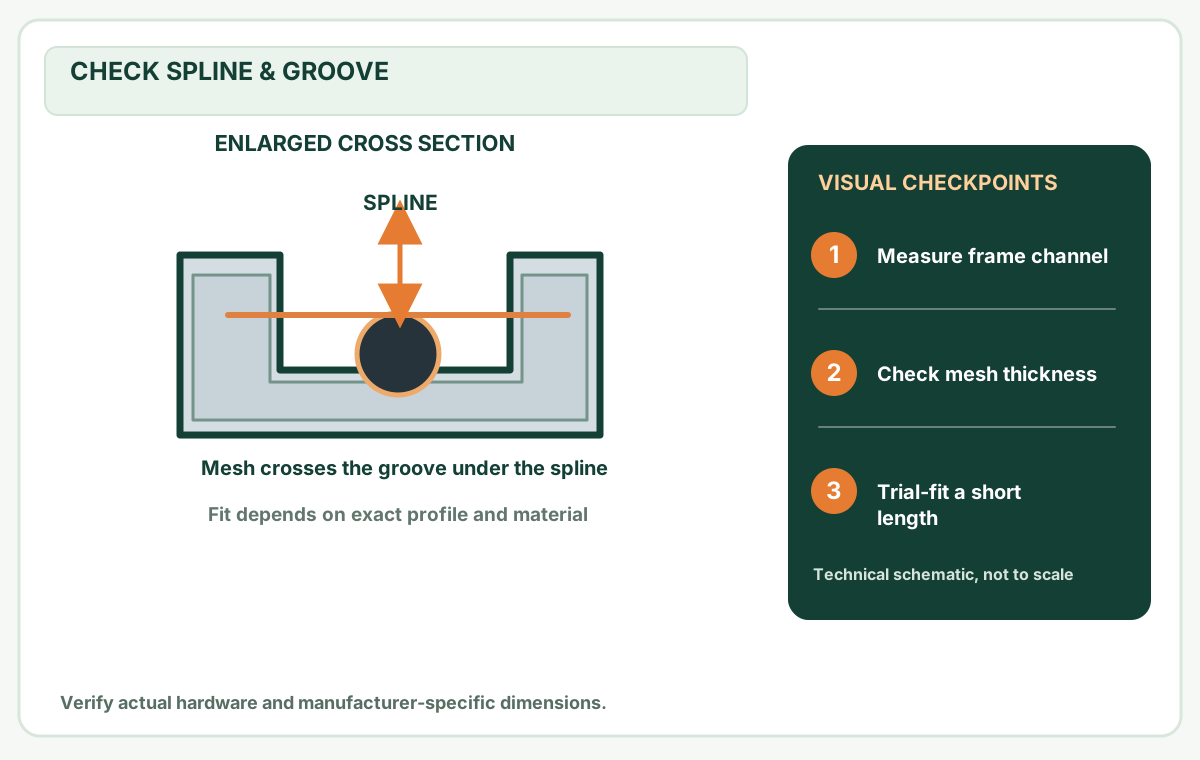
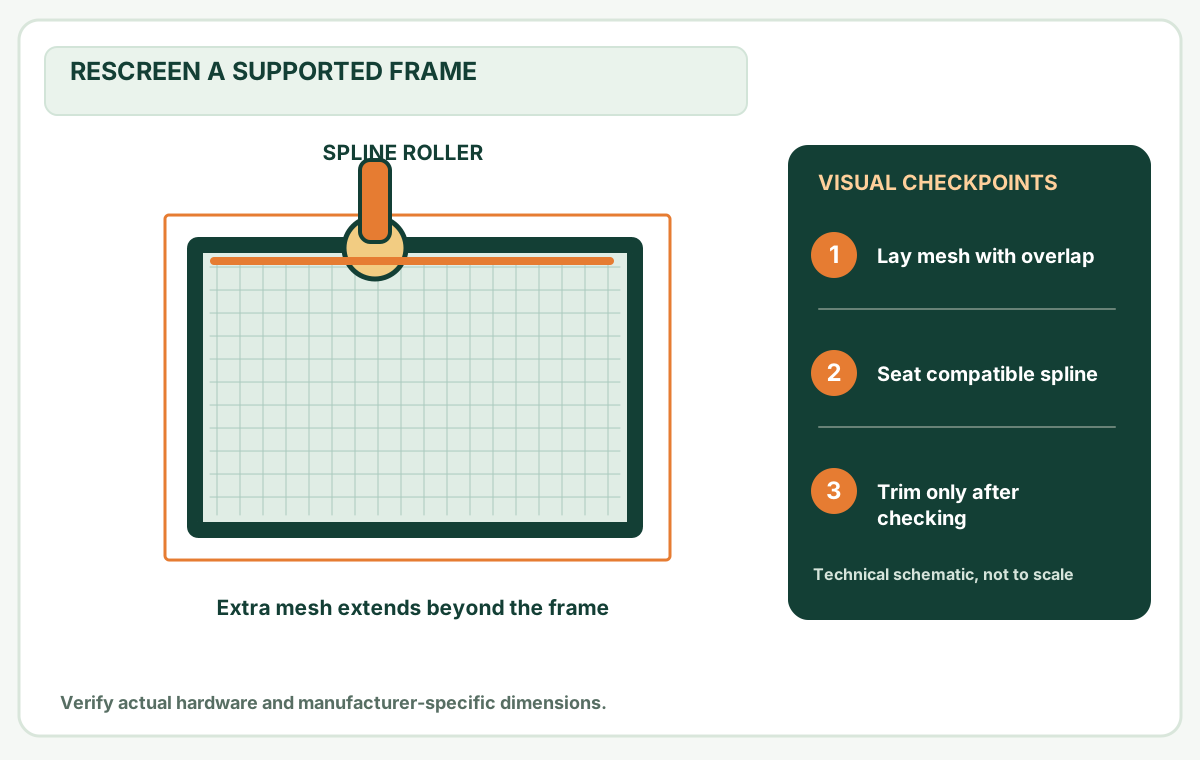
Mesh count describes openings per inch in each direction; it does not alone specify wire thickness, airflow or insect protection.
Before you buy or repair
- Record first
- Manufacturer mesh specification and opening/visibility priority
- Make the decision
- The exact product’s strand diameter, mesh construction and intended insect type
- Stop & verify if
- A count label alone is being treated as proof of airflow, light or pest exclusion
Jump to a section
- Diagram checkpoints
- Count what the numbers actually describe
- Original worked example: how thinner yarn changes the answer
- Two purchasing cases: decide by the problem
- What manufacturer airflow claims do—and do not—let you conclude
- Fit check before buying a different mesh
- What the measurements cannot certify
- Primary sources and evidence limits
- After the project: did it work?
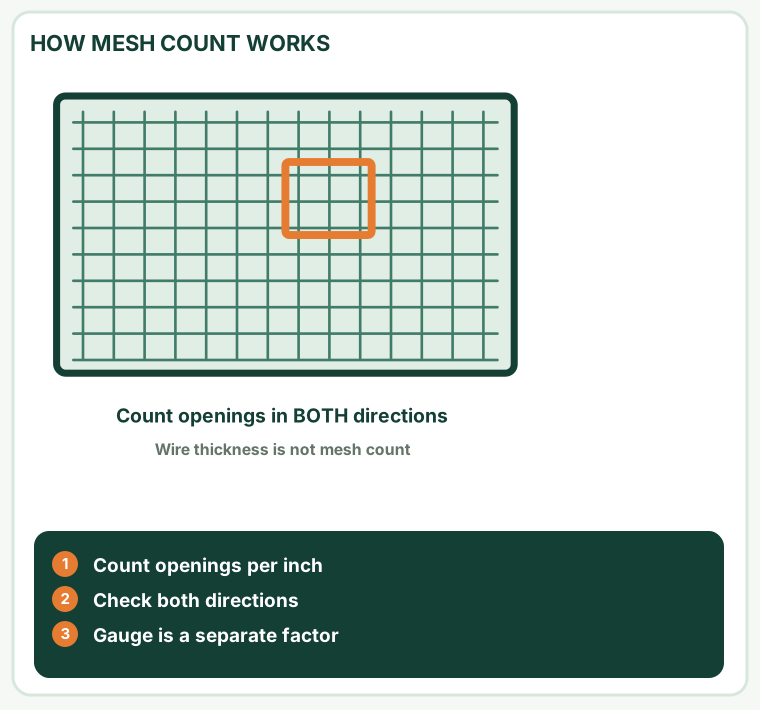
Open desktop diagram ↗ Open mobile diagram ↗
Read the diagram: three checkpoints
- Count openings per inch
- Check both directions
- Gauge is a separate factor
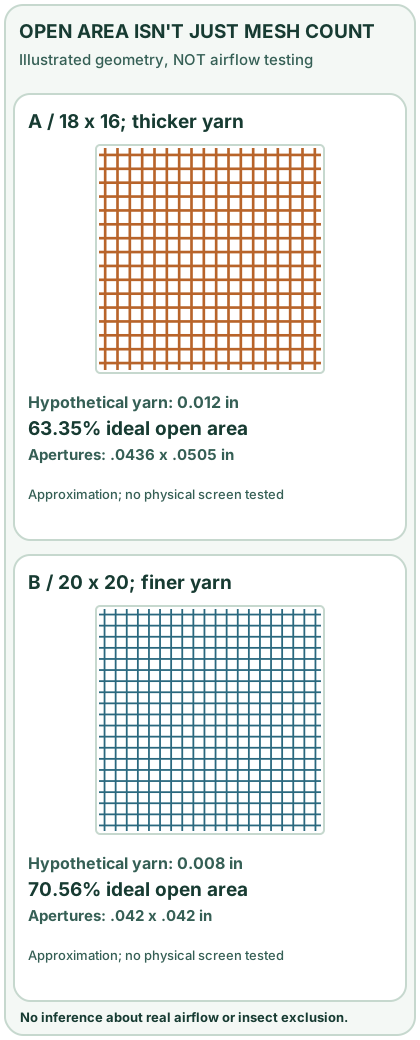
18×16 and 20×20 describe how densely a woven insect screen is constructed. They are not window-frame dimensions, a quality rating, or a guaranteed airflow percentage. You can have a higher mesh count with smaller openings and still more total open area if the yarns are thin enough.
This guide separates three measurements that often get mixed up: mesh count, clear opening (aperture) and open area. Phifer's screen terminology guide documents the distinction for woven screening products.
Count what the numbers actually describe
For a conventional rectangular weave, 18×16 refers to approximately 18 strands (yarns/wires) per linear inch in one direction and 16 in the other, and 20×20 to about 20 strands per inch in both directions. Those are nominal weave counts; a count alone does not specify the clear hole size. This matches Phifer's definition of mesh count. Those numbers do not identify the outside size of your framed window screen.
To identify an unlabeled screen, Phifer's manufacturer FAQ describes placing a one-inch square reference against the mesh, aligning it to the weave and counting openings across each direction. This identifies nominal construction, not the exact physical product.
On a narrow screen, scroll this table sideways to see every column.
| Property | What it means | Can 18×16 / 20×20 tell you? |
|---|---|---|
| Mesh count | Nominal strands/yarns per linear inch in each direction | Yes, approximately |
| Aperture | Actual clear hole width/height | No, yarn thickness also matters |
| Open area | Percentage of surface that is unobstructed in projection | No, yarn thickness also matters |
| Airflow | Movement of air under given test conditions | No, geometry is not an airflow test |
| Insect exclusion | How the installed system performs against target insects | Not alone: aperture and perimeter gaps matter |
| Spline fit | How the chosen fabric seats in your particular frame groove | No: confirm actual mesh thickness and maker's chart |
Original worked example: how thinner yarn changes the answer
This is an idealized geometry demonstration, not an actual Phifer product specification or measured ventilation test. Assume a straight, uniformly spaced rectangular weave, identical circular yarn diameter in both directions, and no extra coating at intersections. Under that simplified model:
Approximate open-area fraction = (1 − horizontal count × yarn diameter) × (1 − vertical count × yarn diameter)
Counts here are nominal strands per linear inch and diameter is in inches. The geometric examples idealize evenly spaced strands, not literal measured hole counts. The formula is valid for the stated idealized grid only when the resulting clear gaps remain positive.
On a narrow screen, scroll this table sideways to see every column.
| Hypothetical mesh | Yarn diameter used for illustration | Idealized clear aperture (one direction × other) | Calculated open area |
|---|---|---|---|
| 18×16 weave | 0.012 in | (1/18 − .012) × (1/16 − .012) ≈ .0436 × .0505 in | (1 − 18×.012)(1 − 16×.012) = 63.35% |
| 20×20 weave | 0.008 in | (1/20 − .008) × (1/20 − .008) = .042 × .042 in | (1 − 20×.008)² = 70.56% |
Interpretation: In this constructed example, the 20×20 screen has smaller individual openings, but more calculated open area, because each strand is thinner. Therefore “20×20 always allows less air” is not a sound conclusion from the count alone. Conversely, this calculation does not establish airflow, UV performance, insect resistance, yarn strength or field durability.
The examples deliberately use different yarn diameters. Phifer's explanation of mesh, aperture, openness and yarn diameter describes why all four matter. Real coated or textured screens, nonuniform strands and different weave structures require product datasheets and actual test methods rather than this simplified grid.
Two purchasing cases: decide by the problem
Case A: tiny biting insects are entering. First inspect the screen edges, missing spline and retention hardware. A fine weave cannot stop insects passing around the frame. If the mesh itself is the problem, compare a maker's stated fine-insect product. For example, Phifer names a 20×20 No-See-Um screen for smaller flying insects. That intended-use claim applies to the named product, not every generic roll labeled 20×20. Check the roll width, aperture/performance data and frame compatibility.
Case B: you want clearer views or ventilation. Do not buy a lower mesh-count roll on count alone. Phifer specifically explains that some visibility-focused products achieve more openness with finer yarns even when the mesh construction is denser; check the Phifer FAQ and product specifications. A screen with good airflow can still have poor resistance to pet claws, so identify the main priority first.
What manufacturer airflow claims do—and do not—let you conclude
A weave equation gives a projected opening fraction, not a real pressure-drop or ventilation test. The Phifer insect screening FAQ illustrates the distinction with named products: it reports UltraVue2 as providing 25% better airflow than its standard fiberglass/aluminum reference, and BetterVue and SeeVue as providing 20% better airflow against that comparison. These are manufacturer-stated relative comparisons, not test results created by MendNook, not 25 or 20 percentage points of open area, and not a prediction of airflow through a specific installed window.
On a narrow screen, scroll this table sideways to see every column.
| Question the homeowner actually has | Evidence to look for | Invalid shortcut |
|---|---|---|
| Will a different mesh improve ventilation? | Named product's published airflow or pressure-drop test method, comparable reference, panel area | Applying the 25% relative claim to every fine-weave roll or to room air changes |
| Will small insects stay out? | Manufacturer's intended insect category, clear aperture and four-edge installation fit | Assuming that 20×20 excludes every insect regardless of gaps |
| Can an existing frame accept the roll? | Frame groove and compatible retainer, actual roll width, thickness | Using nominal weave count to choose a new spline |
| Will it look clearer or feel stronger? | Original product transparency/strength data for the same testing conditions | Using idealized open area as a durability or UV-transmission score |
Practical comparison example: a homeowner sees a Phifer No-See-Um 20×20 roll and a visibility-focused product advertised as improving airflow. First decide whether the observed problem is a small insect or limited ventilation. If the insect comes through a loose frame edge, repairing screen fit and retainers matters more than choosing a finer weave. If airflow is the main need, compare the actual product sheets, not the 18×16 and 20×20 labels. Then verify the available roll is wide enough for the full temporary mesh blank, including an installation margin.
What to write on a shopping note: exact fabric SKU, source and date of any percentage claim, manufacturer comparison baseline, intended insect/environment, necessary loose mesh cut width, existing frame/groove and the selected matching spline. That note is more defensible than a ranking built from mesh count alone.
Fit check before buying a different mesh
- Write down the observed problem: insects, reduced visibility, pet scratches, torn strands or sun control. Avoid vague “best mesh” comparisons.
- Identify both the old mesh and frame groove: photograph the old spline and record the maker, frame profile and mesh type if known.
- Compare the exact product specification: nominal count, strand material/thickness, available roll width, intended insect or sun application, and published openness/airflow figures where provided.
- Check the roll and cutting layout: the loose mesh cut must physically fit the roll width and orientation. Use the multi-screen materials planner if cutting several pieces.
- Reconfirm the spline: Phifer's spline compatibility chart differs by frame profile and mesh material. A thicker replacement can need a different spline even if the old material's count looks similar.
- Test safe retention after installation: no lifted groove edges, loose corners or unsecured retainer clips. A screen is not a child fall barrier; see CPSC window safety guidance.
When comparing two adjacent windows, matching color, finish, transparency and orientation may also matter visually. Keep a labeled sample rather than trusting the nominal count alone.
What the measurements cannot certify
A one-inch count is a useful identification clue; the idealized open-area calculation shows how design variables interact. Neither confirms a screen's real airflow, pressure drop, visibility, security, fit, weathering resistance or effectiveness against every insect. For those claims, request exact product data or a manufacturer's named application.
A defensible buying decision: “I need a screen intended for the local insects, my 36-inch loose cut must fit the roll, and my frame groove needs a compatible spline” is stronger than “20×20 is always better than 18×16.”
Primary sources and evidence limits
- Phifer: Understanding window screen terms — manufacturer explanations of mesh count, openness, aperture and yarn diameter.
- Phifer: Screening FAQ — one-inch mesh-count method and visibility/ventilation tradeoffs.
- Phifer: No-See-Um 20×20 product — exact named product and intended small-insect application.
- Phifer: Screening and spline sizing — named material/frame compatibility, not a generic mesh-count-to-spline formula.
Disclosure: The two open-area figures are arithmetic outputs for explicitly hypothetical yarn diameters, not published Phifer product data or MendNook field-test measurements. Mesh and installation effectiveness were not independently tested.
After the project: did it work?
After completing only product-approved work, document what you actually observe instead of assuming a replacement part resolved the fault.
- Success looks like
- You have compared thread count with wire diameter, open area, airflow and application rather than assuming a larger count means better mesh.
- If it still fails
- If manufacturer specifications are incomplete, get the exact product datasheet or test an approved material sample before ordering.
- Keep for next time
- Mesh model; nominal thread counts; actual product properties; application
Keep your actual measurements and observed result in your private project notebook. This is a verification checklist, not a product certification.
My project record: progress and take-home checklist
Select a progress stage if helpful. This is a personal record only, not a claim that MendNook verified your repair.
Includes this guide's specific diagnosis, decision, safety, and outcome checks, plus any note entered above. Nothing is sent to MendNook; downloads and copy operations stay under your control.