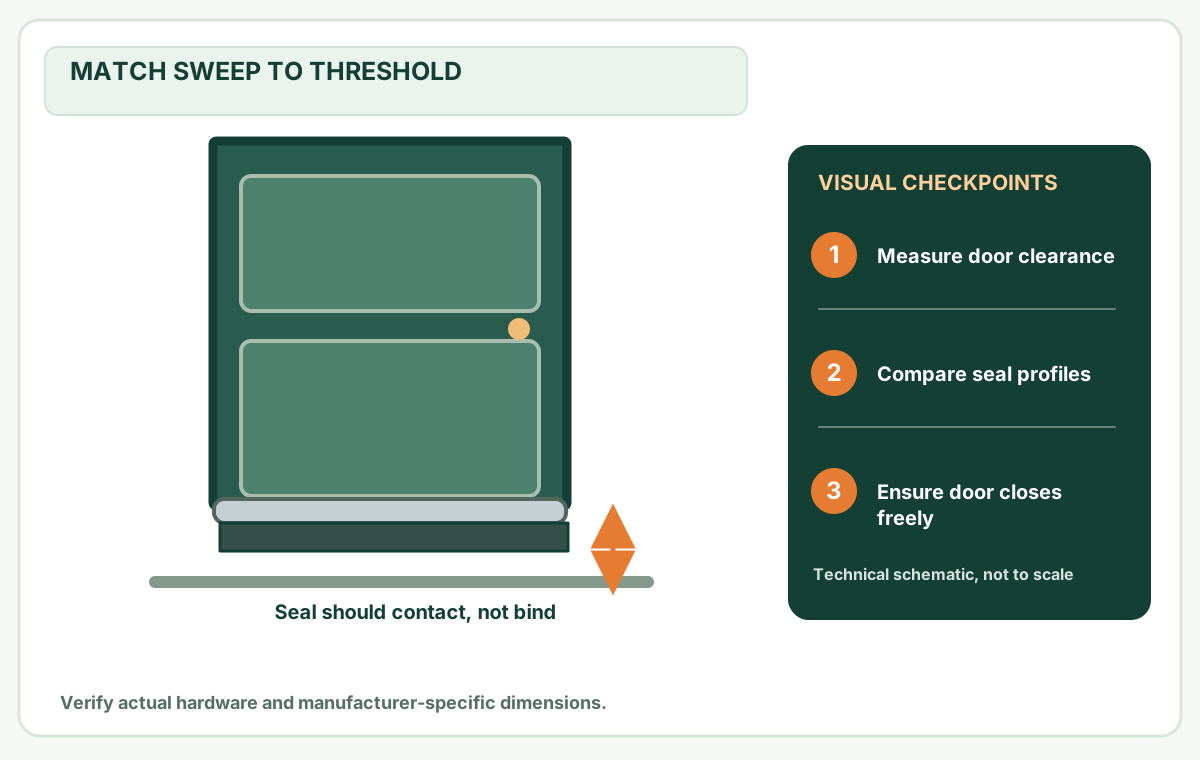
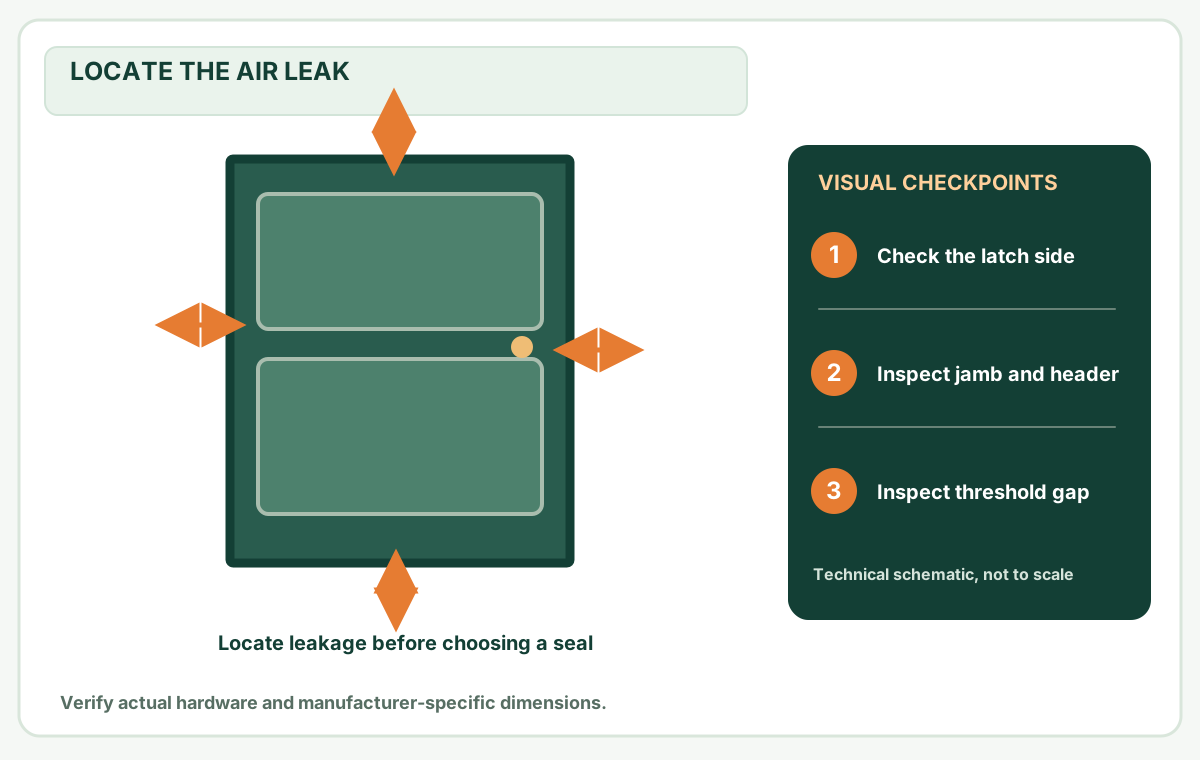
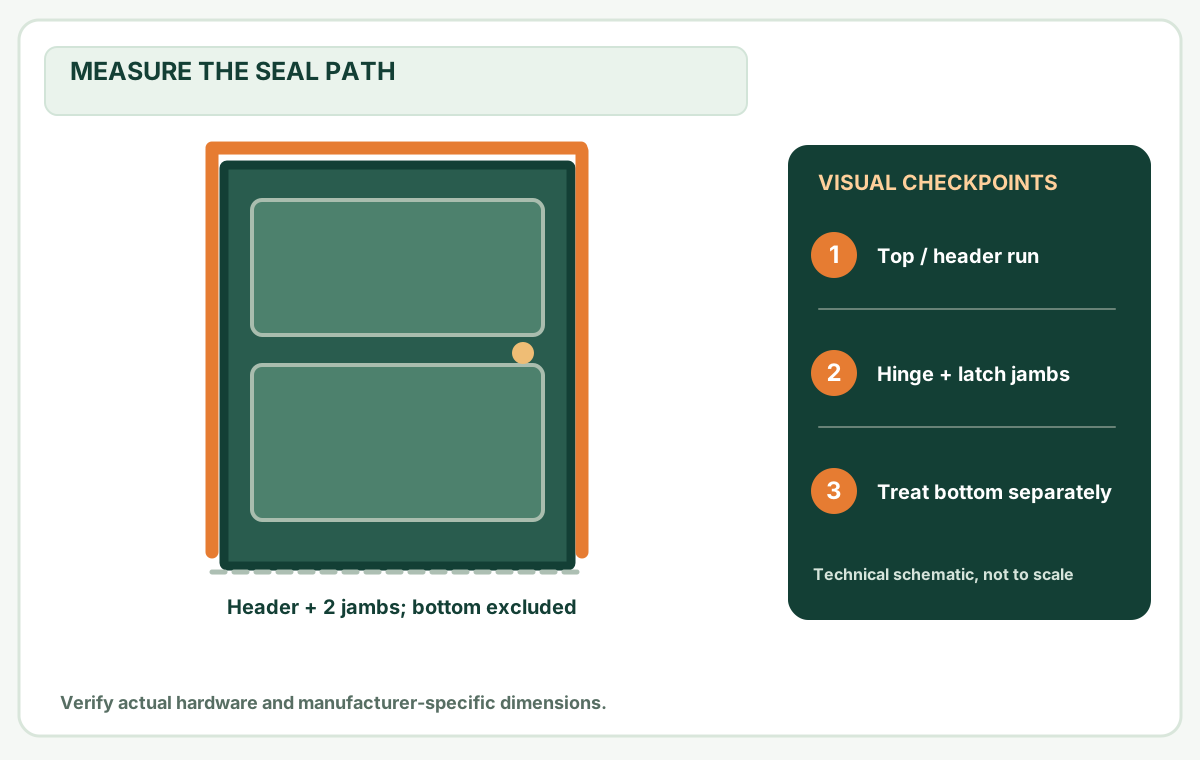
Measure the closed-door gap at hinge, center and latch positions. A single center reading can hide an uneven threshold.
Before you buy or repair
- Record first
- Three closed-door clearances from the same threshold reference
- Make the decision
- Compare minimum and maximum to the chosen sweep working range, not just the average
- Stop & verify if
- The door catches, the threshold is moving, or any sweep obstructs required opening
Jump to a section
- Diagram checkpoints
- First: find the surface you are measuring
- Measure three locations in one consistent condition
- Worked example: compare a minimum, maximum and spread
- Four patterns that change the next step
- Why a 36-inch product label cannot answer the bottom gap
- What to give a supplier: a useful fit request
- Decision: what does the measured gap mean for an actual seal purchase?
- Manufacturer and government sources and limitations
- After the project: did it work?
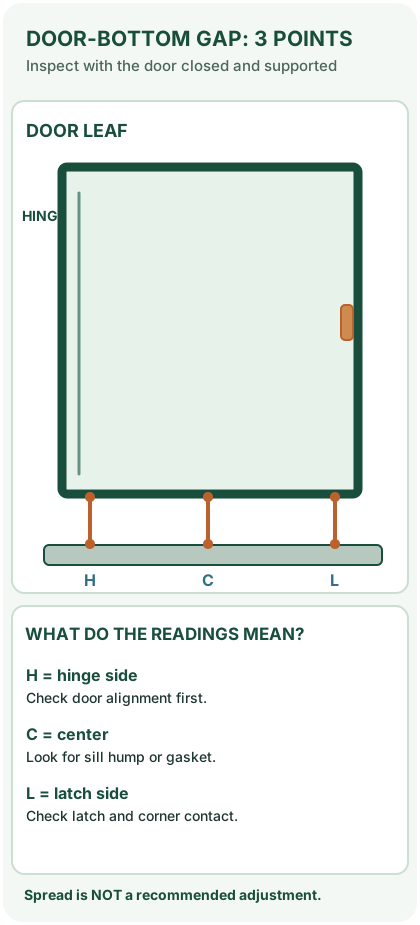
Open desktop diagram ↗ Open mobile diagram ↗
Read the diagram: three checkpoints
- Hinge-side clearance
- Center clearance
- Latch-side clearance
A new door sweep has to contact the correct sill surface without dragging when the door opens or preventing it from latching. One centre reading cannot prove either. Before ordering, note three bottom clearances, the existing door-bottom seal, the actual door width and the surface over which the door swings.
This guide explains how to record the geometry. It cannot identify the proper sweep, certify a manufacturer's allowed clearance, or authorize changes to an emergency-exit or fire-rated door.
First: find the surface you are measuring
A door can have a sloped aluminum saddle, a raised adjustable cap, an integral gasket or a separate door-bottom sweep. Do not assume that the floor, the top of the threshold cap and the exposed underside of the slab are the same reference.
- With the door closed and normally latched, identify the contact surface of the existing bottom seal. If the seal is hiding the physical clearance, mark the reading unknown rather than forcing a metal rule through the gasket.
- Look for a manufacturer or sill label. Do not turn unidentified threshold screws; on some products these are fixings, not height adjusters.
- Check whether you can observe the gap from a safe position at either side. Do not lift the door, remove hardware, put fingers in a closing edge or lean outside an elevated opening for a measurement.
- Draw a simple cross-section: door slab / existing seal / threshold top / adjacent floor. Label your actual reference.
For door systems with an inaccessible gap, the useful result may be a manufacturer/model photo plus the question "Where is the intended measurement point?" rather than an invented number.
Measure three locations in one consistent condition
Mark three points along the lower edge: H = hinge-side, C = centre, L = latch-side. Record them with the door latched normally, always to the same named sill reference. Work in either inches or millimetres; do not mix units between points.
On a narrow screen, scroll this table sideways to see every column.
| Observation | Why it matters |
|---|---|
| Hinge-side gap (H) | Can reveal high contact or a hinge-side obstruction |
| Centre gap (C) | Helps detect a bowed or crowned threshold |
| Latch-side gap (L) | May change if the door sags or does not close fully |
| Actual bottom width | Needed to check the length of the replacement part |
| Door thickness and old seal profile | Needed for slide-on and factory-gasket compatibility |
| Swing path | A sweep can clear the sill when shut yet scrape a rug or floor transition when opened |
If you cannot access all three locations safely, record which ones are missing. A measurement is not improved by forcing a rigid tool against fragile hardware.
Worked example: compare a minimum, maximum and spread
Suppose you observe these hypothetical clearances along one level reference:
On a narrow screen, scroll this table sideways to see every column.
| Location | Fractional inches | Decimal inches | Millimetres |
|---|---|---|---|
| Hinge (H) | 3/16 | 0.1875 | 4.7625 |
| Centre (C) | 1/4 | 0.2500 | 6.3500 |
| Latch (L) | 5/16 | 0.3125 | 7.9375 |
The minimum is 3/16 in; the maximum is 5/16 in. The variation is 1/8 in (3.175 mm). That spread is a description of the opening, not a maximum acceptable tolerance. It tells you why a rigid blade chosen solely for the 5/16-in location might rub at the 3/16-in location. Even a flexible sweep has a product-specific operating range.
Enter your readings into the door-bottom gap checker and compare the result with the candidate part's published contact range, sill pairing and full-swing clearance. If your tape has sixteenths, use the fraction converter to enter consistent decimals.
Four patterns that change the next step
On a narrow screen, scroll this table sideways to see every column.
| What you find | Investigate before buying |
|---|---|
| Similar gaps at H/C/L, door operates normally | Current bottom seal condition and compatible replacement profile |
| Gap widens toward the latch | Door sag, hinge/reveal and latch alignment; see door-fit diagnosis |
| Clearance decreases sharply at the centre | Raised, damaged or crowned threshold; see threshold identification |
| Door scrapes only while swinging | Carpet, tile transition, low spot, sweep mounting height and door arc—not just the closed-position gap |
A sweep can hide the symptom of a misaligned door. Do not file a strike, raise a sill, trim a door or add layers of rubber based solely on these measurements. Water at a bottom corner also needs a drainage and flashing diagnosis, not just a draft-seal purchase.
Why a 36-inch product label cannot answer the bottom gap
One manufacturer example prevents two different dimensions from being confused. Frost King lists its A56/36H automatic sweep at 2 x 36 inches and describes a mechanism that raises while the door opens and lowers as it closes. That published 2-inch product dimension is not a certified seal travel, approved 2-inch air gap or contact range. Likewise, its W79/36H slide-on bottom is listed for 1-3/4-in-thick doors; that is a thickness condition, not a clearance the sweep is designed to cover.
On a narrow screen, scroll this table sideways to see every column.
| Label or measurement | What it records | What it cannot establish |
|---|---|---|
| 36-in catalog length | Nominal length of a retail item | Actual cut length or floor/sill clearance |
| 1-3/4-in door thickness | Width from inner door face to outer door face | Bottom air gap or bulb compression |
| 2-in sweep product dimension | Published overall profile size | Sealing range, actuator travel or mounting side |
| H/C/L closed clearances | Local gaps to a named sill reference | Safe full swing arc or part compatibility on their own |
Worked decision: The illustrative H 3/16 in, C 1/4 in, L 5/16 in readings do not automatically approve a sweep labelled 2 x 36 in. You still need that product's specified contact range, permitted mounting plane and full opening arc. A product with automatic lift may avoid some drag patterns but only if its activator and door assembly support it.
Six-field supplier request: "Door make/series and inswing/outswing: __; thickness and actual bottom width: __; sill make and contact surface: __; H/C/L clearances when normally latched: __; existing bottom-seal profile/photos: __; highest obstacle during opening plus candidate sweep SKU: __. Can you confirm compatible parts and provide the installation drawing?" Leave final part selection pending until a manufacturer or qualified dealer confirms the correct profile and method.
What to give a supplier: a useful fit request
Keep one record with the door brand/series, inswing or outswing, door thickness, width, existing part or gasket cross-section, sill type, H/C/L gaps and reference, and any obstruction in the opening arc. Photograph the part without dismantling tensioned, rated or unfamiliar assemblies.
A useful question is:
“This door has H/C/L clearances of [numbers and units], measured from [the exact threshold surface]. The door is [brand/model, swing, thickness] and currently has [part/profile]. Does your named replacement seal fit this sill and stay clear over the complete swing while allowing normal latching?”
After the repair, verify smooth opening and latching through several gentle cycles, even contact at the intended sill and unchanged drainage/ventilation. If there is scraping, a new leak, unsafe hardware or latching difficulty, stop.
Decision: what does the measured gap mean for an actual seal purchase?
Do not buy from the largest of the three numbers alone. The target replacement is not merely a strip long enough to reach the sill at one point: it must keep normal door operation at the smallest clearance, and make its intended seal contact at the widest clearance only within the maker's published working range.
On a narrow screen, scroll this table sideways to see every column.
| Your measurement / observation | Inspect next | Appropriate related task |
|---|---|---|
| Three clearances similar; old bottom gasket visibly torn | Original door-bottom construction, door thickness, compatible sill pairing | Choose the correct bottom sweep |
| Gap increases from hinge side toward latch and handle needs lifting | Six-point jamb reveals, hinge and frame anchors | Diagnose hinge/door sag before ordering |
| Gap varies around a documented adjustable threshold cap | Actual manufacturer adjusters, damage, drainage and safe latch operation | Identify threshold-adjustment limitations |
| Light persists mainly at the lower door corner rather than along the whole bottom | Sill-to-jamb seal pad continuity, water intrusion, outswing/inswing geometry | Compare corner seal pads |
| Water marks appear under threshold or subfloor | Flashing/substrate water source | Stop seal shopping; obtain building-envelope inspection |
Before/after pass and fail checks
Record the exact maker part number, the reference surface for H/C/L readings, and whether the existing gasket compresses or drags. After a permitted replacement, perform several slow full swings, gently close and throw the main latch/deadbolt. Compare the same three reference points and visually confirm designed drainage remains unobstructed. Any sticking, new rubbing, failed latch or water trapped at a designed outlet means the intervention fails, even if daylight looks reduced.
For a fire-rated or designated emergency-exit door, the product's rated configuration and applicable codes override a homeowner's worksheet. Do not trim the door or substitute an unapproved sweep on the basis of gap arithmetic.
Manufacturer and government sources and limitations
The U.S. Department of Energy's 2024 exterior-door weatherstripping job aid treats air-leak reduction and correct door operation as joint goals. Natural Resources Canada's door weatherstripping guidance distinguishes compression gaskets, door bottoms and sill-mounted strips, which are not automatically interchangeable.
For seal family and compatibility, continue to the door sweep selection guide. Neither public source specifies a universal acceptable spread for all door systems. The arithmetic above is an illustrative worksheet, not a physically tested installation or manufacturer's tolerance chart.
After the project: did it work?
After completing only product-approved work, document what you actually observe instead of assuming a replacement part resolved the fault.
- Success looks like
- Hinge, center and latch clearances were recorded against the same threshold reference, and you know the smallest, largest and spread.
- If it still fails
- If the door drags or the gap changes sharply, resolve door/threshold geometry before ordering a fixed-range sweep.
- Keep for next time
- Three measured clearances with units; threshold type; latch and swing result
Keep your actual measurements and observed result in your private project notebook. This is a verification checklist, not a product certification.
My project record: progress and take-home checklist
Select a progress stage if helpful. This is a personal record only, not a claim that MendNook verified your repair.
Includes this guide's specific diagnosis, decision, safety, and outcome checks, plus any note entered above. Nothing is sent to MendNook; downloads and copy operations stay under your control.