Confirm the door material, clearances and sweep working range. A sweep that drags heavily can make the door bind.
Before you buy or repair
- Record first
- Gap at hinge, middle and latch side while closed
- Make the decision
- The sweep working range, threshold shape and whether the door can still latch freely
- Stop & verify if
- The door is fire-rated, binds, or has a threshold that creates a trip/egress problem
Jump to a section
- 1. Identify your existing door-bottom system
- Read the diagram: three checkpoints
- 2. A real manufacturer example: one door brand, two bottom seals
- Compare five real Frost King products: the listed length is not a fit guarantee
- 3. Take four measurements before selecting a part
- 4. Decide whether a seal is actually the repair
- 5. A useful buyer specification card
- 6. Pass/fail after installing a manufacturer-compatible part
- Primary sources and limits
- After the project: did it work?
A door sweep works only if its material can contact the right threshold surface while the door still opens and latches normally. A bottom brush, a screw-on rubber blade and a factory kerf-mounted door-bottom gasket may all be sold as “door sweeps,” yet they use different fixing methods and work differently with the sill.
Before shopping, identify the old component. If a factory seal clips into grooves on the underside of the door, a generic surface-mounted sweep is not automatically its replacement. If rain is entering around the sill, a new draft seal alone is not a substitute for correct drainage or flashing.
1. Identify your existing door-bottom system
On a narrow screen, scroll this table sideways to see every column.
| What is installed now | First compatibility check | Common wrong assumption |
|---|---|---|
| Factory kerf/snap-in gasket under the door | Door manufacturer/series, groove spacing, profile, sill type | Any 36-inch slide-on sweep will fit |
| Screw-on flexible blade at the bottom face | Fixing side, free swing arc, suitable fixing substrate and contact height | Any blade can be attached to either face |
| Surface-mounted brush | Bristle length, floor/threshold geometry, exterior exposure | A brush is a waterproof sill solution |
| U-shaped slide-on channel | Exact door thickness, underside clearance, any original kerfs | Door width is the only size that matters |
| Automatic drop seal | Product's permitted installation method, activating mechanism and door assembly classification | Any spring-loaded model fits an ordinary exterior door |
| Integral threshold gasket | Exact sill and removable insert model | The insert is part of the moving door |
Some designs seal against an adjustable threshold cap. Before replacing the door-bottom component, check whether that cap is damaged or incorrectly set, using the door-maker's procedure; do not randomly turn unidentified sill screws.
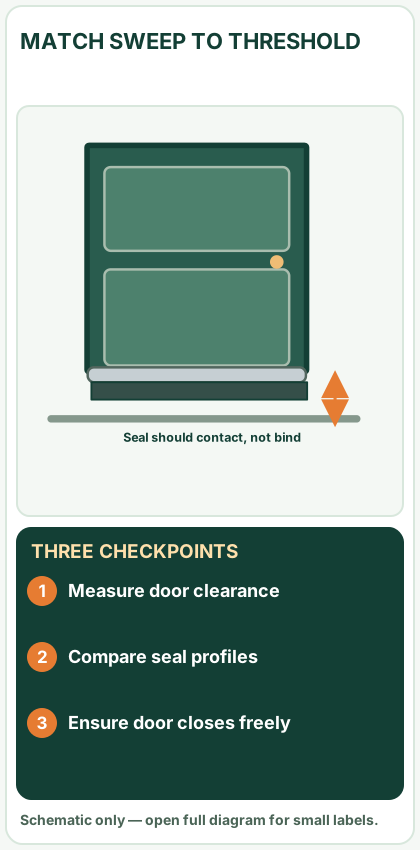
Open desktop diagram ↗ Open mobile diagram ↗
Read the diagram: three checkpoints
- Measure door clearance
- Compare seal profiles
- Ensure door closes freely
2. A real manufacturer example: one door brand, two bottom seals
Therma-Tru's manufacturer FAQ distinguishes single-bulb and dual-bulb door-bottom sweeps on its systems. It states that the single-bulb type is used with moderate-climate and basic fixed sills, while dual-bulb variants are used with composite adjustable, hardwood adjustable and basic composite adjustable sills. These are Therma-Tru system-specific pairings.
What this tells the buyer: Two bottom seals that look similar from the doorway may fit different sill designs from the same manufacturer. Record the door series and sill before ordering. This is not a suggestion that every fixed sill needs one bulb, or that adding a second bulb automatically improves an unrelated door.
Frost King's door-sweep support page adds a second example: for many inswing residential doors its surface sweeps mount on the inside, while outswing installations can place the sweep on the outside. It cautions that the sweep should not scrape across the threshold along the opening path. These are product-specific guidance and a useful swing-direction check, not a universal permission to drill any door face.
Therma-Tru outswing exception: an extra sweep may not be necessary
The same Therma-Tru FAQ says its outswing doors do not require a bottom sweep, although it offers an outswing sweep as an option. This is not a claim that no outswing door ever needs a seal; it shows why a salesperson's generic “every exterior door needs a sweep” rule can be wrong. Check whether your exact door's engineered bottom system already makes proper contact.
On a narrow screen, scroll this table sideways to see every column.
| Door you can positively identify | Published manufacturer distinction | Buyer decision before drilling or ordering |
|---|---|---|
| Therma-Tru inswing door with moderate-climate/basic fixed sill | FAQ describes single-bulb door-bottom pairing | Confirm door generation and matching original part |
| Therma-Tru inswing with specified composite/hardwood adjustable sill | FAQ describes dual-bulb pairing | Check actual sill family, not just door width |
| Therma-Tru outswing system | FAQ says a bottom sweep is not required, although one is offered | First inspect original threshold and provided seal; ask whether accessory is appropriate |
| Unidentified outswing door or any other brand | No Therma-Tru rule applies | Obtain that door maker's service/fit specification first |
An additional blade on the wrong side can scrape the full door swing, interfere with the sill or worsen a water path. Document the current seal and where it fails, then compare the named manufacturer's diagrams. No amount of “extra gasket” substitutes for failed sill flashing, a deformed leaf or a rated-assembly specification.
Compare five real Frost King products: the listed length is not a fit guarantee
The Frost King catalog makes the practical distinction clearer than generic types. These are manufacturer-published examples, not interchangeability recommendations for Therma-Tru, Stanley or other door systems.
On a narrow screen, scroll this table sideways to see every column.
| Named Frost King product | What the published listing actually says | What to verify before buying |
|---|---|---|
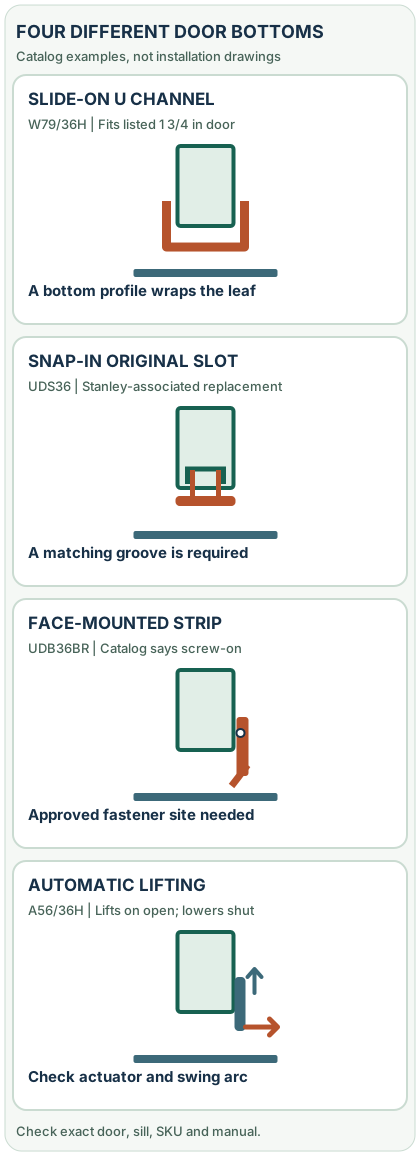
| W79/36H slide-on U-shaped bottom | For 1-3/4-in-thick wood or steel doors; 36-in length | Door thickness and underside profile, factory gasket condition, slide-on clearance; a nominal 36-in width does not guarantee compatible sill contact |
| UDS36 snap-in vinyl replacement | 1-3/4 x 36-in, listed for Stanley doors; the same catalog page lists screw-on UDB36BR, nail/glue UDX36 and slide-on UDB77 as distinct attachment methods | Identify the existing kerf/seat and actual door model. A shared length and thickness do not make snap-in, screw-on and slide-on parts interchangeable |
| A56/36H automatic sweep | 2 x 36-in catalog size; raises as the door opens and lowers when closed | Confirm allowed mounting side, actuator contact and full-swing clearance; 2 inches is a listed product dimension, not a permitted 2-in sealing gap |
| SDB36WH adjustable storm-door bottom | 1 to 1-3/4-in adjustable thickness x 36-in; a two-piece snap-together storm-door assembly | Check compatible storm-door construction; its width adjustment range does not establish exterior entry-door sill compatibility |
| A79/36A reinforced-rubber surface sweep | 2 x 36-in published product size | Check drawing, fasteners, mounting side and sill contact. Same listed size as A56/36H does not mean the same mechanism |
Worked shopping rejection: A door is nominally 36 inches wide and 1-3/4 inches thick. Both W79/36H and UDS36 appear dimensionally plausible, but one is a slide-on profile and the other is a Stanley-related snap-in replacement. Do not buy either from dimensions alone. Identify the original attachment geometry and ask the door or sweep manufacturer to confirm the SKU.
Second rejection: Two sweeps both list 2 x 36 inches. One is a mechanically automatic lifting design; the other is reinforced-rubber surface sealing. These dimensions do not tell you their compression range, fitting plane or whether a moving threshold contact is supported.
Safety/operation priority: Frost King's sweep placement FAQ says a sweep should not cross the threshold through the opening arc. Read the exact part instructions and check the door manufacturer's rules before drilling or trimming a rated, insulated or reinforced assembly.
3. Take four measurements before selecting a part
- Door bottom width — record the actual usable lower-edge length, not just a nominal 30/32/36-inch door label.
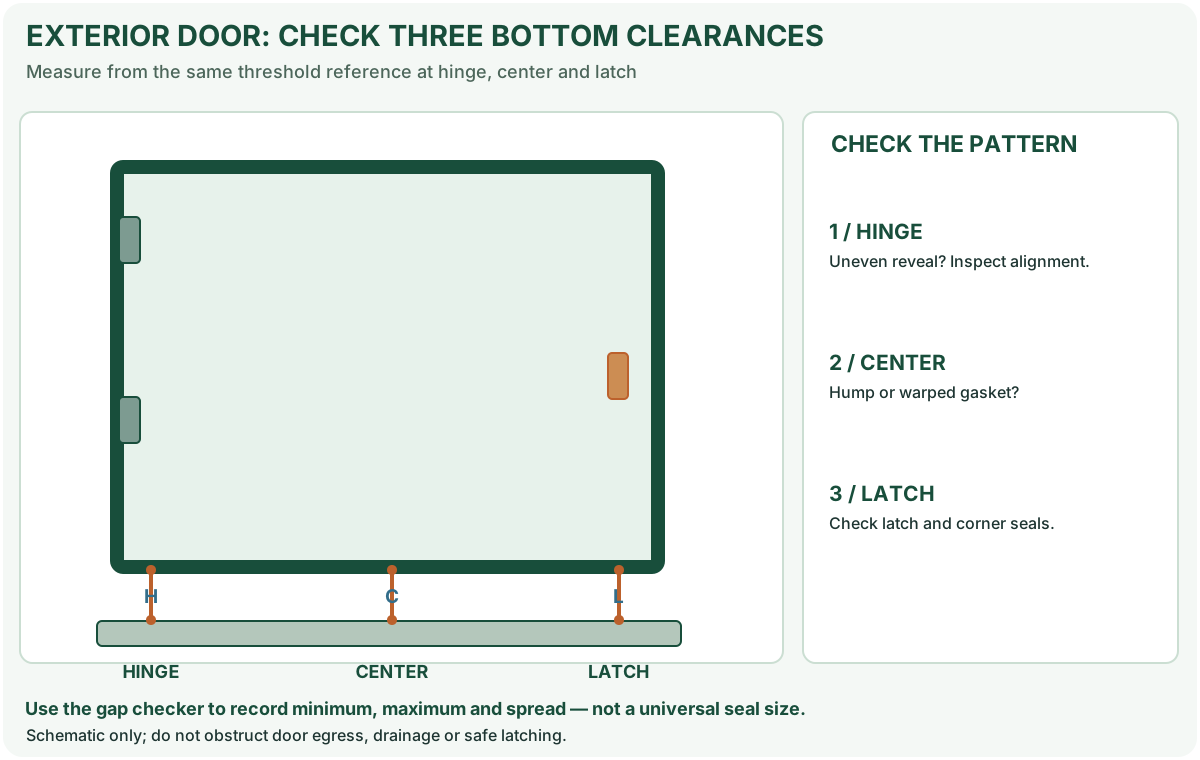
- Three bottom clearances — with the door shut, measure leaf-to-sill distance at the hinge side, center and latch side, always from the same reference. Use the door gap checker to compare minimum, maximum and variation.
- Door thickness / seal attachment — essential for a slide-on or factory-gasket system; take a photograph of the old cross-section, groove and mounting holes.
- Operating path — note any carpet, raised tile, floor transition, threshold high spot or weather-exposed location that the door crosses while swinging.
Hypothetical worked check: The three bottom gaps are 1/8 in, 3/16 in and 5/16 in. The spread is 3/16 in. A proposed rigid strip sized only for the largest gap may drag at the hinge end. You cannot know whether any real product works from these numbers alone: match the candidate's published contact range, swing clearance and sill geometry, then review whether misalignment needs repair first.
Never substitute the largest number for all three. Nor should a mathematical average be treated as an approved setting.
4. Decide whether a seal is actually the repair
On a narrow screen, scroll this table sideways to see every column.
| Observation | Most useful next check | Why more sealing material may fail |
|---|---|---|
| Door drags or requires lifting to latch | Hinge/reveal diagnosis | Door alignment prevents even seal contact |
| Water enters at bottom corner | Sill drainage, jamb/sill intersection and corner seal pads | Bottom sweep cannot repair failed flashing or a rotten jamb |
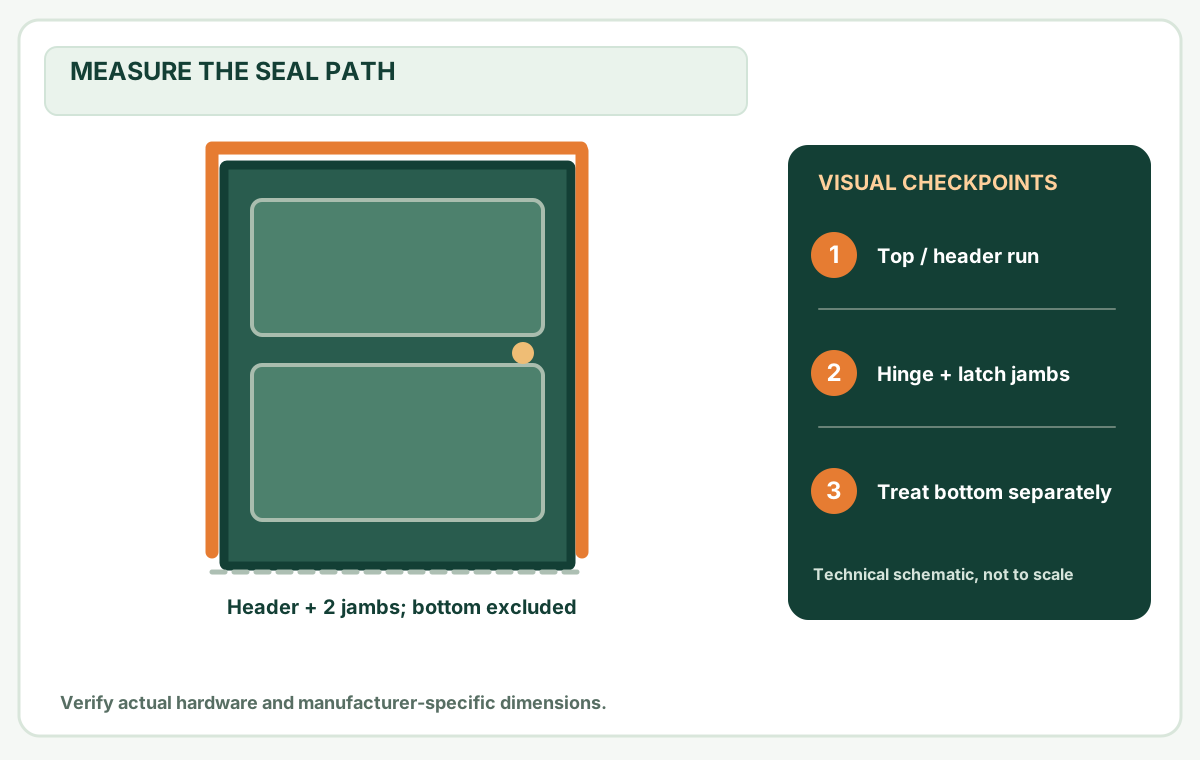
| Draft only on latch edge | Perimeter weatherstrip and latching | A bottom-only seal addresses the wrong opening |
| Brush or blade rubs the floor while door opens | Sweep placement and the full swing arc | Closed-position clearance is not the only clearance |
| Factory gasket torn but sill is sound | Same-door manufacturer replacement profile | Aftermarket U-channel may conflict with kerf retention |
| Commercial, fire-, smoke-rated or emergency-exit door | Approved assembly documentation and qualified installer | Generic DIY replacement may invalidate required operation |
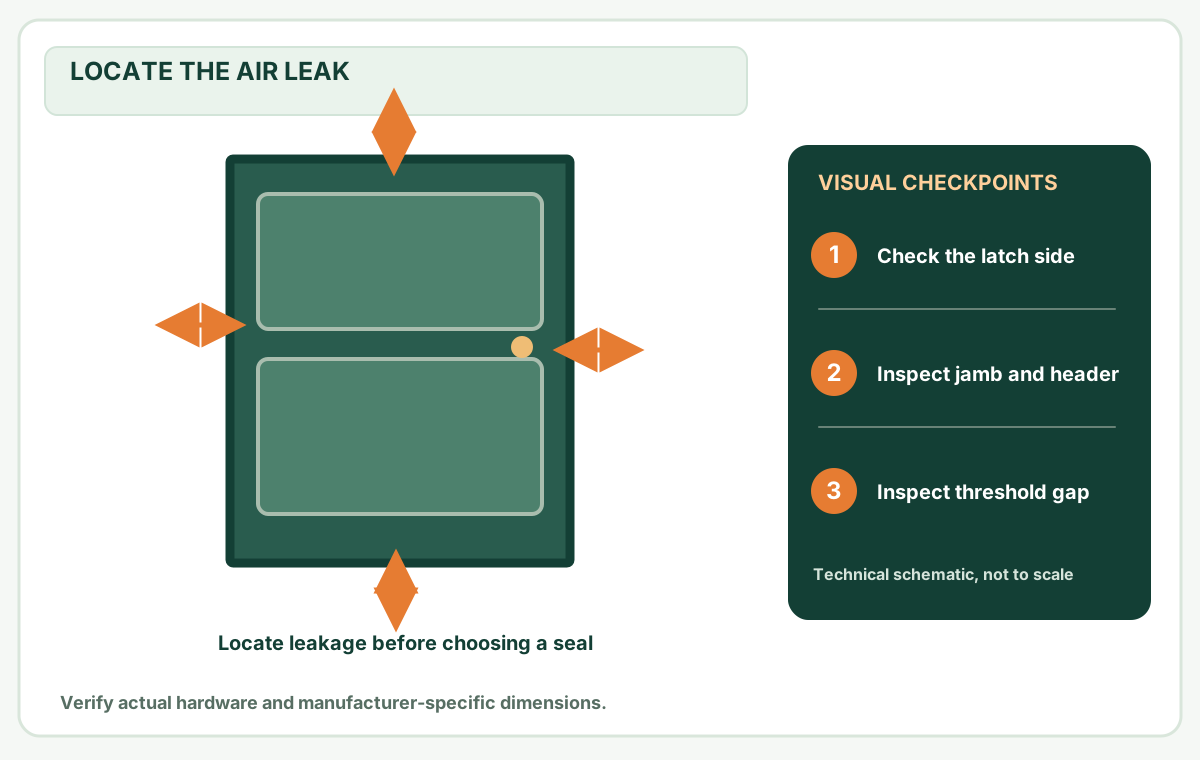
To identify the leak before purchasing anything, use the five-zone door draft diagnosis. Do not seal designed ventilation, threshold drainage or emergency egress.
5. A useful buyer specification card
Take this record to the manufacturer's parts desk or retailer:
On a narrow screen, scroll this table sideways to see every column.
| Field | Example of what to record |
|---|---|
| Door/sill | Visible brand, model/series, inswing or outswing, fixed or adjustable sill |
| Existing bottom | Kerf gasket, slide-on channel, screw-mounted blade, brush, or threshold insert |
| Sizes | Actual door width and thickness; three clearances with units |
| Installation | Old fixing holes, kerf locations, exposed face material, swing-path obstruction |
| Verification needed | Exact part number, published operating clearance, intended threshold contact, permitted fasteners |
Use the manufacturer's installation steps for any permitted fixing or trimming. Do not drill an unknown door, distort a sill channel or combine rubber profiles merely to force a seal to contact.
6. Pass/fail after installing a manufacturer-compatible part
The U.S. DOE / NREL exterior-door weatherstripping job aid treats reduced air infiltration and proper door operation as joint desired outcomes. Check both, not just whether the door feels quieter.
- The door closes and latches without extra force; deadbolts, closers and escape hardware remain operational.
- The seal has the intended contact without folding, binding or scraping during a full gentle opening/closing cycle.
- The threshold still drains as designed; no sealing compound blocks an intended water path.
- No new daylight or uneven contact appears at the corners after a few cycles.
- If water or air still passes, stop and re-diagnose rather than layering another strip.
An altered door that cannot latch, a sweep that catches underfoot, or damaged rated hardware fails, even if the visible gap is smaller.
Primary sources and limits
- Frost King: Product family and attachment types — manufacturer catalog, not compatibility approval.
- Frost King: Named snap-in, screw, nail/glue and slide-on options.
- Frost King: Automatic A56/36H.
- Therma-Tru: manufacturer FAQ (single- versus dual-bulb bottom sweeps) — demonstrates product/sill-specific pairings.
- Frost King: door sweeps, bottoms and thresholds support — specific swing-side and installation considerations.
- U.S. DOE: exterior-door weatherstripping job aid (PDF) — installation outcome and safe door operation.
Scope: The clearance figures are hypothetical teaching measurements, not tested sweep specifications or manufacturer-approved tolerances. Neither brand has inspected your door; the exact product and local safety rules control actual installation.
After the project: did it work?
After completing only product-approved work, document what you actually observe instead of assuming a replacement part resolved the fault.
- Success looks like
- Door opens through its full swing, latches normally and the sweep contacts the intended threshold without significant dragging.
- If it still fails
- If it rubs or still leaks at one corner, recheck all three clearances and verify the sweep's published working range; stop if operation is impaired.
- Keep for next time
- Door width; hinge/center/latch clearance; sweep model; result of full-swing and latch test
Keep your actual measurements and observed result in your private project notebook. This is a verification checklist, not a product certification.
My project record: progress and take-home checklist
Select a progress stage if helpful. This is a personal record only, not a claim that MendNook verified your repair.
Includes this guide's specific diagnosis, decision, safety, and outcome checks, plus any note entered above. Nothing is sent to MendNook; downloads and copy operations stay under your control.