
DECISION GUIDE / WINDOW SCREENS
Repair or Replace a Window Screen? A Practical Decision Matrix
Decide whether to patch screen mesh, rescreen a sound frame, repair retention hardware or replace a damaged frame—without guessing order dimensions.
If the frame and hardware are sound, repairing or rescreening may make sense. Otherwise identify the original mounting system before ordering.
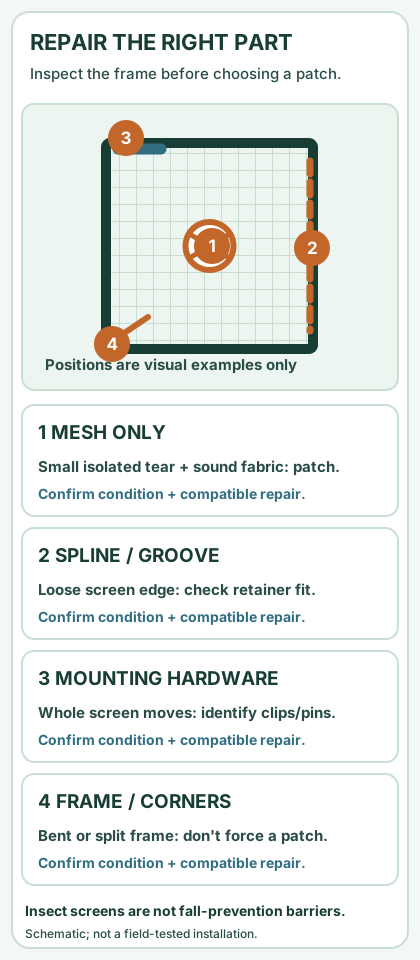
When a window screen is torn, loose or no longer fits, the whole screen does not automatically need replacing. Start by separating the screening mesh, the spline or retainers, and the frame. They are different parts with different failure modes and purchasing measurements. This guide helps you decide which to inspect next—not order a made-up “standard” replacement size.
Compare the repair choices
On a narrow screen, scroll this table sideways to see every column.
| What you find | Check before buying | Reasonable next action | Do not assume |
|---|---|---|---|
| One small isolated hole, firm surrounding mesh, sound frame | Is the mesh still securely retained? Is the damaged area small enough for the patch method? | Follow the fiberglass-versus-aluminum patch guide and choose the exact material-compatible kit | Any patch can restore severely brittle mesh |
| Long tear, widespread holes, brittle or sagging fabric, straight usable frame | Look for loose spline, clean grooves, intact corners | Rescreen the existing frame if its channel and retention system are suitable | A new frame is required just because the mesh is torn |
| Mesh slips out of one side | Inspect spline diameter, groove and mesh thickness | Verify a compatible spline and test a short section before full rescreening | Every spline thickness works with every frame |
| Visible gap to the window, frame looks straight | Check retaining clips, springs, tabs and mounting track | Restore missing compatible hardware or confirm frame fit first | Adhesive filler will fix missing retention hardware |
| Frame corners separate, rails bow, or diagonals differ | Measure both outside widths and heights, both diagonals, and inspect joints on a flat surface | Consult the frame maker or an experienced screen shop about frame repair/replacement | Averaging measurements gives an orderable new-frame size |
| Old screen missing | Identify window model, retaining track and spring/clip mechanism | Follow that supplier's hardware-specific measuring instructions | Glass or visible opening width equals finished screen width |
For physical damage around glass, inaccessible upper-floor openings, unstable frames or anything that requires leaning outside, stop and arrange safe professional assistance. The screen is not a fall-protection barrier or security device.
Three decision examples
Case 1: Mesh torn but the frame still seats correctly
You have a rectangular 30 × 24 in framed screen. The corners are sound and it still locks into the same window. You may be able to retain the existing frame and replace only its mesh and suitable spline. A planning example with one inch of working overhang on each side gives a loose 32 × 26 in mesh cut. The existing frame perimeter is 108 in (9 ft). Adding a chosen 10% buying allowance gives 9.9 ft of spline for this example. These numbers help plan material; they are not an order size for a new framed screen. Enter your actual readings in the screen material calculator and check the spline compatibility guide.
Case 2: The frame binds and the two width readings disagree
The frame measures 30 1/8 in at the top but 29 7/8 in at the bottom—a 1/4 in difference. Do not average these figures into a purchase size. The frame may be bowed, racked, measured at inconsistent points, or fitted to an unfamiliar track. Check both diagonals and inspect corners before deciding whether the frame is reusable. Use the frame squareness guide or the dimension checker.
Case 3: No original screen exists
A photo of the glass does not reveal which mounting arrangement the new framed screen will use. Record the manufacturer/model, the deep and shallow tracks, spring or plunger positions, mounting lip, and frame depth. Take photographs beside a ruler. Then follow the intended supplier's order-size procedure. The screen measurement decision assistant explains why mounting-system-specific instructions are required. There is no trustworthy universal frame-size deduction for an unidentified opening.
Which supplies do you actually need?
- Small patch: Use the material-specific patching walkthrough to distinguish adhesive fiberglass from hooked aluminum methods. Check surrounding intact mesh, patch coverage and the exact kit instructions; do not rely on a patch for widespread degradation.
- Rescreening: Screen roll, a spline of the correct tested size, spline roller, appropriate cutting tools, and a clean flat work surface. Check the frame groove before buying.
- Retention repair: Exact replacement tabs, clips, springs or other hardware that fits the existing mounting design; photos and dimensions matter.
- Complete replacement frame: Recorded outer dimensions if a known-good old frame exists, or the vendor's track-specific measurements if it does not; confirm depth, color, clips and orientation before ordering.
Variation in published methods matters. The Home Depot's screen repair guide describes roughly a 1/2-inch mesh overlap when positioning mesh; This Old House suggests about 2 inches extra on all sides in its workflow. These are different example methods, not conflicting finished-frame dimensions. Your own working allowance should fit your mesh, roller method and frame without leaving you short. The calculator lets you adjust it rather than prescribing one supplier-independent amount.
Before paying for parts: a five-point verification
- Confirm the failure. Is it fabric, spline, hardware, frame, or the window track itself? A torn screen and a bent frame are different jobs.
- Identify the measuring reference. Mark the worksheet
existing frame outer dimensionsortrack/opening measurement; never mix them. - Check the maker's compatibility instructions. Mesh type, groove size and spline often work as a system; different fabric thicknesses can change the compatible spline.
- Inspect the risk. Avoid unsupported ladders, leaning beyond windows, sharp broken glazing, and unstable or heavy frames.
- Keep an order record. Photograph mounting hardware, note all dimensions and the vendor's published measuring rule, then verify what will actually be shipped.
The printable measurement worksheet can help record your evidence before ordering. If the screen will be exposed to pets, insects or strong weather, consider the mesh specifications and retention method rather than comparing nominal mesh labels alone.
Common questions
Is a patch always cheaper than rescreening?
Not necessarily. A patch might use less material, but the right decision depends on damage spread, mesh condition, patch compatibility, locally available supplies and the time you want to invest. We do not publish invented average prices. Compare the current actual costs of a patch kit, mesh/spline materials and a shop's quote for your screen.
Can a bent screen frame be straightened?
Some minor frame issues may be repairable by a specialist, but a frame that has visibly separated joints or a distorted channel can stop retaining mesh correctly. Forcing a badly damaged frame back into the track can create additional problems. Start with the bent-frame inspection guide and follow the manufacturer or screen shop's advice.
Can I order a replacement by measuring the glass?
No. Screen mounting tracks and retaining hardware differ from the visible glass dimensions. For a missing original screen, use the measurement path tool and the precise supplier instructions—not a generic subtraction formula.
Editorial method and published references
This is a research-based decision guide, not a report of hands-on tests or an affiliate product ranking. The repair categories are grounded in public how-to instructions; fit and safety choices must be checked against the current maker information for your window. Where published tutorials give different example cut allowances, we show that variation instead of treating either as universal. Sources: The Home Depot repair/replacement guide, This Old House replacement walkthrough, and Phifer's screening and spline sizing guide. For corrections, consult our editorial policy or contact page.
Important: MendNook has not physically tested these repairs or installations. These comparisons do not promise fit, cost, energy savings or compatibility; confirm the product-specific instructions before buying.