
DECISION GUIDE / DOOR SEALS
Door Sweep vs Weatherstripping: Find Which Seal You Need
Diagnose door-bottom versus jamb drafts before choosing a sweep, perimeter weatherstripping or threshold repair; check gap variation and safe closure.
A door-bottom sweep does not seal the side jamb. Locate the draft, confirm door operation and only then match a component to the measured gap.
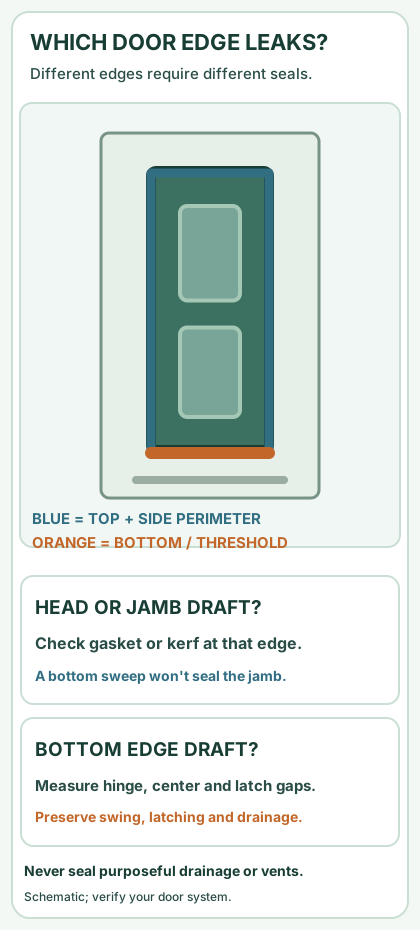
A cold feeling near an exterior door does not prove that its bottom sweep is the problem. Air can enter near the lock-side jamb, hinge side, top header, threshold joint or a separate glazing detail. Different leak locations require different parts. Use this symptom-first checklist before buying seal materials or adding a thick strip that makes the door difficult to close.
Door sweep, perimeter strip or threshold: compare the job
On a narrow screen, scroll this table sideways to see every column.
| Evidence you observe | Possible component to inspect | What to measure/check | When to stop or reconsider |
|---|---|---|---|
| Light or air at the bottom of a closed door | Door-bottom sweep, door shoe, threshold seal | Bottom clearance at hinge, middle and latch positions; seal travel and threshold profile | Door drags, is misaligned or rubs hard enough to affect latching |
| Air leaks along the vertical jambs | Compression, foam, silicone, vinyl or other compatible perimeter weatherstripping | Actual runs, available contact surfaces and compression when latched | Existing strip is intact but the door is warped or misaligned |
| Leak at the top edge | Header weatherstripping or fit | Header contact and correct closure, plus top seal length | Door rubs or cannot shut/latch after adding material |
| Air appears to enter under or around the threshold | Threshold-to-floor joint or threshold seal | Threshold condition, gaps at the base and any moisture intrusion | Water damage, deteriorated substrate or missing structural support |
| Leak changes when latch engages | Strike plate, hinges, jamb alignment, door compression | Observe seal compression while safely closing the door | Door needs force to latch or safety/fire-rating requirements apply |
| One gap is much larger than another | Door geometry, uneven threshold, worn hinge or existing seal | Compare closed-door bottom clearances in three positions | Proposed sweep cannot cover both the minimum and maximum gap without dragging |
Key distinction: A door sweep attaches to the bottom of the door; perimeter weatherstripping seals against the jamb/header; a threshold is the sill component underfoot. These can work together, but one does not automatically substitute for another. Natural Resources Canada's weatherstripping reference describes the different families and their installation constraints.
Run a draft check without unsafe tests
- Inspect in daylight. Look for obvious worn material, open gaps and detached sections while the door is fully closed. Do not rely on a flame, smoke source or unattended heating equipment to locate a leak.
- Check the latch and hinges first. A misaligned or warped door may not compress even a new seal. Any adjustment should preserve safe operation, especially on rated or emergency-exit doors.
- Identify the leaking edge. Mark bottom / hinge jamb / latch jamb / header / threshold joint. Several edges can need attention at once.
- Measure the affected runs separately. Use actual top and side lengths for jamb weatherstripping; use the bottom gap at three locations before considering a sweep or shoe.
- Compare the manufacturer's compression or sweep range. More material is not automatically better. Oversized weatherstripping can prevent full latching; an oversized sweep can drag and wear.
- Check the source of water, not just the draft. If the sill, subfloor or surrounding wall is wet, softened or visibly damaged, do not conceal it behind an adhesive strip. Get the underlying problem evaluated.
Example A: the draft is at the lock-side jamb
The bottom sweep looks intact, but a narrow air path appears beside the closed door near the latch. Replacing the sweep would not target that edge. Inspect the jamb contact, compression seal, hinge/strike alignment and the latch-side length. A simple planning example uses 80 in of side seal and 36 in of header seal if those are the actual measured runs; that is 116 in or 9 ft 8 in before any chosen cutting allowance. Do not extrapolate this to every door or include the bottom when it uses a separate product. Use the weatherstrip length calculator with your measured lengths.
Example B: the bottom gap varies across the door
The closed-door clearance reads 3/8 in by the hinge, 1/4 in in the middle and 1/2 in near the latch. That 1/4-in spread matters: a seal that contacts the lowest clearance might bind at the narrowest point, while one sized for the narrow point might not reach the largest. First check threshold level, hinge alignment and the selected product's operating range. The door gap checker reports your minimum, maximum and spread; it does not prescribe a sweep model or certify a fit.
Example C: the threshold is visibly deteriorated
A bottom draft coincides with soft, loose or wet material at the threshold. Do not just apply a stick-on seal and call the repair complete. Threshold damage, water entry and subfloor deterioration can require a different repair sequence. Photograph the condition and consult an experienced installer when the substrate or structural support is uncertain.
Real product exception: an outswing door may not need an added sweep
It is tempting to take a bottom-gap symptom as proof that every exterior door must receive a screw-on sweep. Therma-Tru's own door-system FAQs say its outswing doors do not require a bottom sweep, although an optional outswing accessory is available. Its named single-bulb and dual-bulb bottom seals also pair with different sill systems. That is a manufacturer-specific compatibility exception, not a claim about every door brand.
On a narrow screen, scroll this table sideways to see every column.
| Identified door system | What's actually worth checking | Don't buy simply because… |
|---|---|---|
| Therma-Tru outswing with original bottom system | Does its specified sill/seal already meet intended contact? Does the maker allow the optional accessory? | You can see a strip of daylight from one angle |
| Therma-Tru inswing with fixed/basic versus adjustable sill | Which documented single-/dual-bulb original part matches the sill family? | “Double bulb” sounds like a better universal replacement |
| Other brand or unknown manufacturer | Original bottom profile, sill construction, swing arc and published compatible parts | Another brand shows a sweep in a tutorial |
| Wet sill or draft from below the threshold base | Water management, frame bedding and flashing separately from moving-door gasket | A sweep looks easier than a substrate repair |
The DOE/PNNL Building America door air-sealing guide separately addresses continuous moving-door perimeter gaskets, fixed rough-opening air sealing, exterior flashing, and door-bottom contact. A seal that only makes the door harder to lock fails the DOE exterior-door weatherstripping job aid's proper-operation goal.
Ordering checkpoint: photograph the existing sill from the same side as the door swing, record the door's original manufacturer/model, document the smallest and largest closed-door gap, and obtain the manufacturer's accepted bottom profile before choosing a part. Do not drill into unknown door skins or alter rated/emergency-exit assemblies.
Before purchasing any seal
- Record door material, swing direction, current sweep/threshold type and whether the doorway is a required exit or rated assembly.
- Check whether a replacement needs screws, a press-on channel, an adhesive surface or a special profile. Avoid drilling into glazing or unidentified door cores.
- Measure the gap in the closed, latched position without forcing the door.
- Follow the door manufacturer's instructions for correct seal pressure and whether a sweep may contact a threshold.
- For perimeter seals, buy based on actual side and header runs and the product's specified cutting/joining method.
- After installation, verify full closing, latching and unobstructed egress—never accept a seal that makes the door unsafe to operate.
FAQ
Can I use one weatherstripping roll along the bottom and sides?
Usually the door bottom uses a different assembly from the perimeter because it must accommodate movement and the threshold. Some systems have compatible coordinated pieces, but do not assume a generic adhesive roll is suitable everywhere.
Does a door sweep also stop water?
A sweep may reduce some air or debris entry, depending on the seal and threshold, but is not a substitute for correct flashing, drainage or a sound sill. Visible water damage is a reason to investigate more deeply.
How much clearance should be left under an exterior door?
There is no trustworthy universal number. Different door constructions, thresholds, sweeps and fire/accessibility requirements have different limits. Record the actual gap and match the assembly to manufacturer specifications rather than forcing an arbitrary value.
Should I replace the sweep if the door sticks?
Not automatically. The door could be out of alignment, the threshold could be high or the existing seal could be the wrong profile. Inspect the source and verify that any change preserves safe closure.
References and editorial scope
This is research-based advice, not field-tested installation evidence. Therma-Tru's official FAQ documents brand-specific bottom seal and outswing exceptions. DOE/PNNL's envelope resource distinguishes fixed rough-opening air barriers and flashing from moving-door gaskets, and the DOE 2024 job aid requires proper door operation. Natural Resources Canada: weatherstripping materials and door bottoms explains the basic components and mounting considerations. For site-specific dimensions, consult the door/sweep manufacturer. Our door-bottom gap guide, sweep selection guide and draft-source troubleshooting guide provide the next steps; read our editorial policy for research limitations and corrections.
Important: MendNook has not physically tested these repairs or installations. These comparisons do not promise fit, cost, energy savings or compatibility; confirm the product-specific instructions before buying.