Moisture location matters: room-side droplets usually call for humidity control; inaccessible fog between panes may indicate IGU seal failure.
Before you buy or repair
- Record first
- Which surface is wet, indoor humidity, time/weather and any evidence of trim moisture
- Make the decision
- Separate indoor humidity management from possible failed insulated glazing unit service
- Stop & verify if
- The frame is rotting, mold or water damage spreads, or moisture is trapped between panes
Jump to a section
- Diagram checkpoints
- First test: which surface is actually wet?
- Measure room humidity without treating a number as a verdict
- Two worked cases: what evidence actually changes the purchase?
- Why a humidity number alone cannot diagnose a window
- A weather pattern can help distinguish exterior dew from a failed glass unit
- A seven-day observation record instead of guesswork
- Climate and region: what changes, and what does not?
- Sources and limitations
- After the project: did it work?
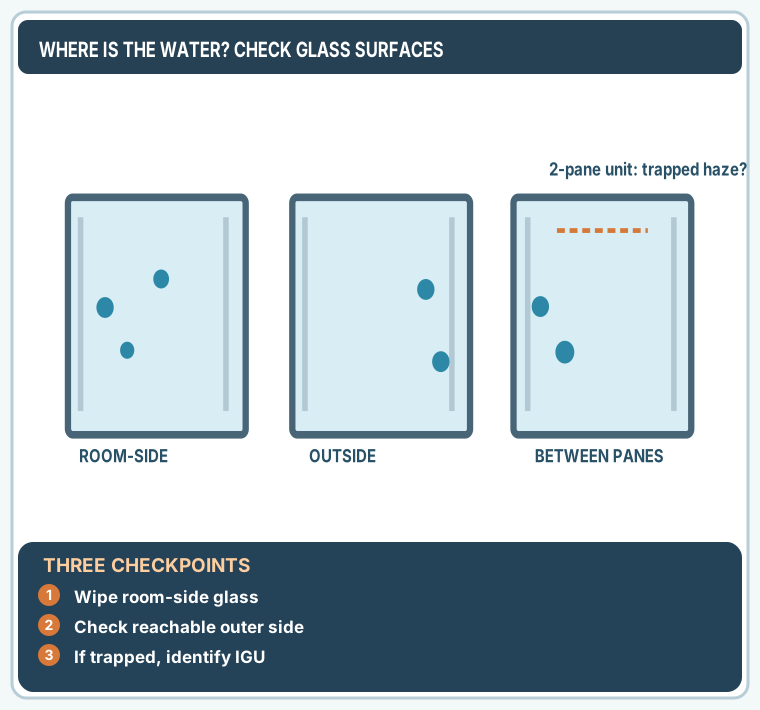
Open desktop diagram ↗ Open mobile diagram ↗
Read the diagram: three checkpoints
- Wipe room-side glass
- Check reachable outer side
- If trapped, identify IGU
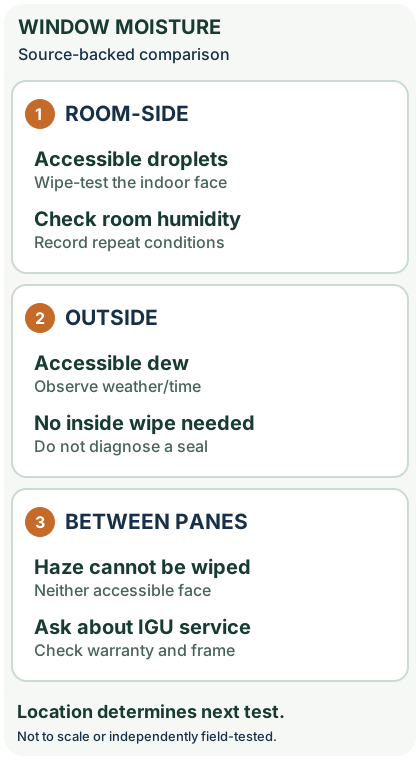
Before replacing a window, locate the wet surface. Droplets on the room-side glass can result from indoor moisture reaching a cool surface. Dew on the exterior pane is often a weather effect. Haze sealed between the panes of an insulated-glass unit (IGU) can indicate a failed perimeter seal. These are three different situations; more caulk or a dehumidifier will not solve them all.
This guide provides a safe observation and purchasing decision, not a laboratory diagnosis of sealed-glass performance or a substitute for inspecting a leak-damaged wall.
First test: which surface is actually wet?
From inside the room, photograph the affected window in natural light. Wipe only the accessible room-side glass with a clean, dry cloth; note whether droplets or haze disappear. Look for condensation on the outside without leaning out, climbing or opening an elevated window. If the exterior cannot be safely reached, mark it as unconfirmed rather than claiming the moisture is trapped between panes.
On a narrow screen, scroll this table sideways to see every column.
| What you can observe | More useful explanation to investigate | First action |
|---|---|---|
| Room-side droplets disappear when wiped | Indoor water vapour meeting cold glazing | Check ventilation, indoor RH, room temperature and moisture sources |
| Outside dew changes with weather | Exterior surface cooling and ambient humidity | Observe again; outside dew alone is not a sealed-unit failure |
| Haze persists behind both accessible surfaces | Possible moisture within a multi-pane sealed unit | Record brand, warranty and photos; request a glazing assessment |
| Wet trim, soft sill, stains or spreading mould | Condensation damage or a separate water-intrusion problem | Dry safely, investigate the source, stop cosmetic caulking |
Limit of this test: a coating, inaccessible outside surface or ordinary dirt can look like inter-pane haze. If you cannot distinguish them safely, get a glazing professional to identify which surface is affected. Pella's condensation guidance distinguishes interior, exterior and between-pane moisture.
Measure room humidity without treating a number as a verdict
Use a functioning hygrometer away from showers, steam plumes or air outlets. At the same time, record room temperature, indoor relative humidity (RH), outside weather, time of day and exactly which glass face is wet. A reading taken during cooking cannot be compared directly with one from a quiet, dry room.
The U.S. EPA mold-and-moisture guide recommends indoor RH below 60% if possible, ideally 30–50% as a general moisture-control range. These values do not test an IGU seal and do not guarantee a dry window in cold weather. Colder glazing can condense water at a lower indoor RH, depending on surface temperature and the home's conditions.
For room-side moisture, first address an identifiable source: bathing, cooking, drying clothes indoors, a humidifier or inadequate extraction. Confirm that fans and vents operate as designed, dry the wet sill and observe again under comparable conditions. Do not block intentional ventilation, combustion air or trickle vents to stop a draft.
Two worked cases: what evidence actually changes the purchase?
Case A — moisture wipes off the room-side glass. At sunrise a window has droplets inside, the indoor RH reads 64%, and a dry cloth clears the glass. These are hypothetical observations, not a MendNook test. A sensible next step is humidity management and rechecking, not ordering sealed replacement glass. If the sill remains wet or mould forms, escalate the moisture problem promptly.
Case B — haze remains in the sealed cavity. After cleaning the safely reachable inner face, a cloudy pattern appears to lie between panes and does not change. The next step is confirming the moisture plane with the glazing maker/installer; if inter-pane fog is verified, ask about IGU-only, sash-only and full-window repair options and the manufacturer's warranty. A room dehumidifier will not reseal the failed IGU edge.
On a narrow screen, scroll this table sideways to see every column.
| Quote item to request from a supplier | Why it matters |
|---|---|
| Exact affected component — IGU, sash or complete frame | Avoid replacing sound components unnecessarily |
| Brand/model/serial or glazing label | Product-specific service and warranty eligibility |
| Glass specification, coating and spacer details | Replacement appearance and performance can differ |
| Included labor, removal/disposal and finish repair | Compare complete service scope, not only unit price |
| Who warrants the repair and its limits | A quoted “defogging” procedure is not necessarily restoration of the original insulated unit |
Do not confuse a clearer-looking pane with independently verified recovery of its original gas fill or thermal performance.
Why a humidity number alone cannot diagnose a window
Condensation depends on which glass surface is cold enough relative to the air touching it. NOAA's dew-point explanation describes condensation as air cooling to its saturation (dew-point) temperature. A hygrometer's room RH describes room air at the meter's location, not glass surface temperature or the condition of the sealed cavity. The same room RH can therefore accompany droplets on one colder pane and no droplets on a warmer pane.
Use the observations below to choose what to check next, not to claim an insulated-glass failure from humidity:
On a narrow screen, scroll this table sideways to see every column.
| Controlled comparison | What it helps rule in or out | Next observation, not a premature purchase |
|---|---|---|
| Several room-side panes become wet after showering, cooking or indoor laundry | A common indoor moisture load is plausible | Check extraction and dry surfaces; repeat at similar weather and room conditions |
| One room-side pane stays wet while neighboring windows are dry | Local cold surface, low air movement, shading or construction differences may matter | Check sash/trim condition, indoor airflow and whether this precise surface wipes clean |
| Moisture appears just after wind-driven rain, especially under a sill | Water intrusion may be occurring independently of condensation | Inspect substrate, flashing/drainage and refer recurring dampness for qualified assessment |
| Haze appears internal and cannot be wiped from accessible faces | Possible inter-pane moisture or a coating/dirty inaccessible face | Identify the glass plane before requesting an IGU assessment, not an automatic full-window replacement |
| Window dries after ventilation but between-pane fog remains | Room moisture improvement does not restore an IGU perimeter seal | Check maker warranty, serviceable unit/sash options and written scope |
A useful two-visit comparison
Hypothetical example: on Monday morning you record a bathroom at 20°C and 68% RH, after a shower, with droplets on the accessible inner face of two windows. You dry the surfaces and use the normally installed bathroom extractor. On another morning, under comparable outdoor conditions, you record 20°C and 47% RH and no room-side droplets. This supports checking moisture control first; it does not measure a window's U-value, prove an energy saving or certify a sealed glass unit.
For a different example, the inside face wipes clean, but a cloudy patch still seems to lie between two panes. The correct next action is a manufacturer's service assessment—not applying a new caulk bead to the glass. Pella's support FAQ specifically distinguishes room/exterior condensation from moisture within insulating glass.
Safety and uncertainty: Never climb outside to wipe an upper pane, remove glazing beads, obstruct purposeful vents or put an unapproved temperature probe against damaged glass. When there is a wet electrical fitting, rotting frame, persistent mould or water flowing inside the wall, escalate the moisture issue promptly.
A weather pattern can help distinguish exterior dew from a failed glass unit
Pella's manufacturer condensation explanation, updated May 18, 2026, names high outdoor humidity, little wind and clear night skies as conditions favorable to exterior dew. The observation may be strongest early in the morning and may clear as the sun warms the outer glass. That is useful evidence, but it is not a guarantee: the same window can have different moisture locations at different times.
On a narrow screen, scroll this table sideways to see every column.
| Observation from a safe indoor position | Why it matters | Next evidence |
|---|---|---|
| Fog appears at dawn after a clear, calm, humid night, then fades as the sun reaches the pane | Outside dew is plausible; exterior moisture alone does not prove insulating-glass failure | Note time, weather, which face is accessible, and compare again when the glass warms; do not lean outward to wipe it |
| Fog stays visible even when the inside face has been wiped dry | Could be outside moisture, inaccessible dirt/coating or inter-pane moisture | Do not assume seal failure yet if you have not identified the outside face; send accessible photos to the glass supplier |
| Moisture repeats between glass panes after both safely reachable faces are ruled out | A sealed-unit fault is plausible, as Pella's FAQ explains | Check the unit warranty, IGU-only or sash-only service, coating match and quote scope before replacing the entire frame |
| Rain-linked wet sill but no fog, especially with damp drywall | Rain path/flashing failure may be separate from condensation | Investigate damage promptly; do not cover wet material with cosmetic trim caulk |
Worked diary example (hypothetical): two adjacent double-glazed windows look cloudy at 07:00, after a clear, calm, humid night. Both clear after morning sun; there is no wet interior sill and no visible haze later in the day. This pattern makes exterior condensation a better first hypothesis than buying two complete windows. It is not a performance test. If one pane instead remains hazy after other exposed surfaces dry, record that difference for a glazing assessment.
Important sales distinction: A manufacturer's statement that between-pane fog may lead to window replacement does not automatically establish that the entire surrounding frame must be discarded. The serviceable item may be the insulated-glass unit, sash or whole assembly; request written model-specific options rather than assuming an IGU failure mandates a full-frame purchase.
A seven-day observation record instead of guesswork
A few comparable observations are more useful than a one-off humidity reading. Use the browser-local project notebook on this page or copy the table into your own record:
On a narrow screen, scroll this table sideways to see every column.
| Field | Example to record |
|---|---|
| Date / time / weather | Morning, clear and cold; whether outside dew was visible |
| Room temperature and RH | e.g. 20°C / 48% RH, with meter location |
| Exact wet surface | Inside wipes off, exterior seen but inaccessible, between-pane suspected |
| Ventilation / moisture activity | Bath fan running, laundry drying, window trickle vent |
| Damage and outcome | Wet sill? surface dried? stain recurring? |
Repeat after changing a normal, safe moisture source or restoring intended ventilation. A drop in humidity does not prove an energy saving or a repaired window seal. If photos show condensation every day despite normal moisture control, seek assessment of window performance, air paths and local conditions.
Climate and region: what changes, and what does not?
The three surface locations mean the same thing in the US, Canada and UK. What changes is the severity of cold-weather surface cooling, ventilation design, warranty and local installation rules — not the basic diagnostic physics.
- US: EPA moisture guidance emphasizes reducing persistent moisture and drying wet surfaces promptly.
- Canada: Natural Resources Canada's window and exterior-door guidance helps distinguish air-sealing improvements from a damaged glazing assembly.
- UK: Energy Saving Trust's windows and doors guide is a starting point for ventilation and glazing-system questions; do not close intentional vents to chase condensation.
If the home contains damaged porous material, spreading mould, recurring rainwater ingress, electrical components near moisture, or a soft frame, treat this as a building/moisture safety concern rather than a simple glazing-order decision. The EPA moisture guide stresses correcting the actual moisture source. Do not cover wet trim with sealant.
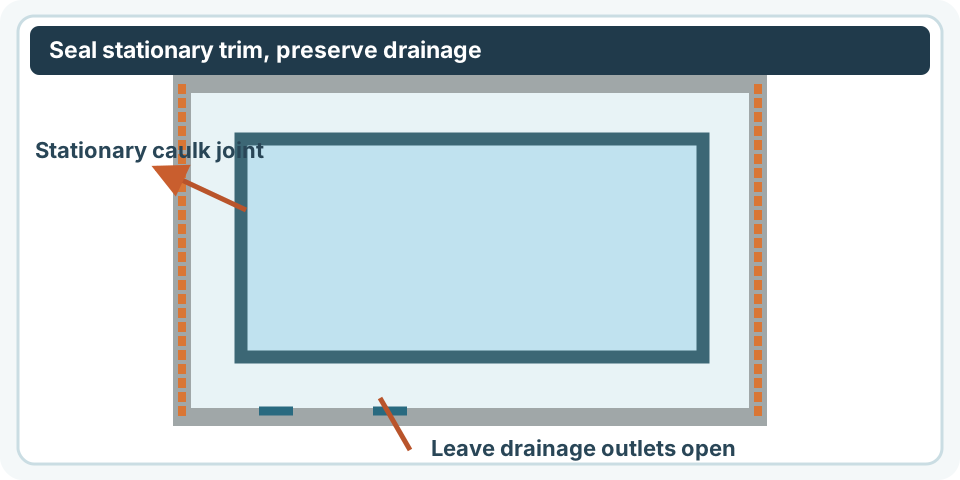
For a dry, stationary trim air leak after water intrusion has been ruled out, see caulking window-trim joints; it is not a repair for a failed IGU perimeter seal.
Sources and limitations
- NOAA: Dew point and condensation explained — explains why temperature at the wet surface matters in addition to room humidity.
- Pella: Official support FAQ for window condensation — distinguishes interior/exterior moisture from insulated-glass seal problems.
- U.S. EPA: A Brief Guide to Mold, Moisture and Your Home — indoor humidity guidance and prompt moisture control.
- Pella: Window Condensation Tips — indoor/outdoor/between-pane distinctions and possible IGU seal failure.
- Natural Resources Canada: Windows and Exterior Doors — air sealing and window-assembly context.
- Energy Saving Trust: Windows and Doors — UK installation, energy and ventilation context.
Evidence boundary: The numbers are worked examples, not measurements from a MendNook case. We have not inspected a real sealed unit or established a particular home's moisture source. Only qualified inspection and product documentation can confirm the failed component.
After the project: did it work?
After completing only product-approved work, document what you actually observe instead of assuming a replacement part resolved the fault.
- Success looks like
- You have located the moisture on indoor/outdoor glass or between panes and recorded whether it recurs with comparable conditions.
- If it still fails
- If fog remains trapped between panes or wood stays wet/moldy, request glazing or moisture professional review.
- Keep for next time
- Water location; room RH; weather/time; wipe test and follow-up
Keep your actual measurements and observed result in your private project notebook. This is a verification checklist, not a product certification.
My project record: progress and take-home checklist
Select a progress stage if helpful. This is a personal record only, not a claim that MendNook verified your repair.
Includes this guide's specific diagnosis, decision, safety, and outcome checks, plus any note entered above. Nothing is sent to MendNook; downloads and copy operations stay under your control.